Monday, June 18, 2012
Liu Yang First Woman Into Space From China
Liu Yang, a 34-year-old air force pilot, and two male taikonauts, Jing Haipeng and Liu Wang, were aboard the Shenzhou 9 spacecraft as it left the Earth on Saturday on a voyage that will see it dock with an orbiting space module.
Two of the crew will live and work inside the bus-sized Tiangong 1 space module for a week to test its life-support systems while the third will remain in the capsule to deal with unexpected emergencies as China bids to become only the third nation with a permanent base orbiting Earth.
State media have said the mission will last about 10 days before the taikonauts travel back to Earth in the capsule that will land in the grasslands of western China with the help of parachutes.
Success in docking, and in living and working aboard the Tiangong 1, would smooth the way for more ambitious projects, such as sending a taikonaut to the moon, and add to China's international prestige in line with its growing economic prowess.
If completed, the mission will put China alongside the United States and Russia as the only countries to have independently maintained space stations, a huge boost to Beijing's ambitions of becoming a space power.
The mission demonstrated China's "commitment to its long-term human spaceflight plan", said Joan Johnson-Freese, an expert on the Chinese space programme at the US Naval War College in Rhode Island.
She said its success would "demonstrate the technological capabilities requisite for a future permanent space station".
Excluded from space station
Still, that is some years away. The Tiangong 1 is only a prototype, and the plan is to eventually replace it with a permanent, and bigger, space station due for completion around 2020.
Analysts say China's exclusion from the International Space Station, largely on objections from the United States, was one of the key spurs for it to pursue an independent programme 20 years ago, which reaches a high point with Saturday's launch.
China first launched a man into space in 2003 followed by a two-man mission in 2005 and a three-man trip in 2008 that featured China's first space walk.
While operating with limited resources, China's space programme is a source of huge national pride and enjoys top-level political and military backing.
The first female taikonaut is giving the programme an additional publicity boost. State media have gushed this week about Liu, pointing out that she once successfully landed her plane after a bird strike disabled one of its engines.
As with China's other female taikonaut candidates, Liu is married and has a child, a requirement because the space programme worries that exposure to space radiation may affect fertility. Aljazeera
Tuesday, June 12, 2012
Indonesia: Three Fantastic Encounters On Bali Island
Lisa's Travel Notes : In my everyday life I’m a big-time planner. I like to research decisions, read reviews, and weigh my options before committing.
You’d think I’d be traveling with a binder full of post-it notes, maps and itineraries. But…I didn’t actually open a guidebook in preparation for this grand adventure. I just found the idea of researching six countries and making plans for over a hundred days on the road far too overwhelming. So, I’ve been taking it a couple of days at time. Looking up options on the internet, asking friends for suggestions and sometimes just stumbling upon great opportunities.
In Bali, I made three delightful discoveries that I just had to share with all of you in case one day your find yourself on the tarmac in Denpasar.
The first is Big Tree Farms Bamboo Chocolate Factory. Many of you have enjoyed the incredible ingredients created by Big Tree Farms without even knowing it. They supply most of the raw food companies in North America with cacao products, cashews and palm sugar.
Recently, they constructed the world’s largest functioning bamboo factory. Here they will process the chocolate products they receive from the 9000 farms in their network. When I arrived they were a week away from actual production but I was able to get a quick tour and purchase some fantastic raw food. I was greeted with such enthusiasm by their staff that it felt like such a treat to just walk around the building listening to them describe the future.
They plan to have regular tours open to the public so I suggest adding a visit to your Bali agenda. Buy some cashew clusters to snack on for an afternoon rice field hike.
I picked up some raw cacao (not quite this much – since I have a luggage limit).
Having raw cacao in my bag means that creations like this are in my future. What sweet potential!
The school welcomes students from all over the world. The curriculum is designed to focus on eco-education and allows for hands-on learning about sustainability. Currently, the school has enrolment from pre-kindergarten to grade 11. Most children live off-campus with their parents but on-site accommodations are starting to fill up with students who have travelled to study at the Green School.
It is a pretty magical place. I can only imagine the energy when it is full of students engaged in learning and enthusiastic play.
You’d think I’d be traveling with a binder full of post-it notes, maps and itineraries. But…I didn’t actually open a guidebook in preparation for this grand adventure. I just found the idea of researching six countries and making plans for over a hundred days on the road far too overwhelming. So, I’ve been taking it a couple of days at time. Looking up options on the internet, asking friends for suggestions and sometimes just stumbling upon great opportunities.
In Bali, I made three delightful discoveries that I just had to share with all of you in case one day your find yourself on the tarmac in Denpasar.
The first is Big Tree Farms Bamboo Chocolate Factory. Many of you have enjoyed the incredible ingredients created by Big Tree Farms without even knowing it. They supply most of the raw food companies in North America with cacao products, cashews and palm sugar.
Recently, they constructed the world’s largest functioning bamboo factory. Here they will process the chocolate products they receive from the 9000 farms in their network. When I arrived they were a week away from actual production but I was able to get a quick tour and purchase some fantastic raw food. I was greeted with such enthusiasm by their staff that it felt like such a treat to just walk around the building listening to them describe the future.
They plan to have regular tours open to the public so I suggest adding a visit to your Bali agenda. Buy some cashew clusters to snack on for an afternoon rice field hike.
I picked up some raw cacao (not quite this much – since I have a luggage limit).
Having raw cacao in my bag means that creations like this are in my future. What sweet potential!
The second special spot I visited on Bali was the Green School. I have been interested in this initiative for a number of months after hearing about it through Tedtalks. Since I was there just before Christmas, classes were on holiday hiatus but it was amazing to wander through the bamboo structures and hear all about the philosophy that instigated the birth of this phenomenal venture.
Can you imagine being sent to the principal’s bamboo hut? or sipping on coconut water during recess at your own juice bar?
The school welcomes students from all over the world. The curriculum is designed to focus on eco-education and allows for hands-on learning about sustainability. Currently, the school has enrolment from pre-kindergarten to grade 11. Most children live off-campus with their parents but on-site accommodations are starting to fill up with students who have travelled to study at the Green School.
It is a pretty magical place. I can only imagine the energy when it is full of students engaged in learning and enthusiastic play.
The school was designed by architects from all over the world. The public is welcome to tour on Mondays and Wednesdays at 3:00 pm. Wandering the grounds and admiring the amazing bamboo structures is quite an experience.
My final discovery was much more of a surprise. On my last day in Seminyak, I went out in search of lunch with a handy list of options from HappyCow. Tasty Vegan was situated on the street I planned to wander so I focused on finding it. I didn’t read the fact that it was a delivery service so I landed on the doorstep instead. What I walked into was a family birthday party and a New Years celebration. Wishnu, the restaurant owner welcomed me with open arms. The restaurant wasn’t officially open but that didn’t seem to matter. I was presented with a beautiful platter of vegan nasi campur, an overflowing plate of vegan cookies and fresh papaya juice.
The huge gathering of Wishnu’s family celebrated my arrival. I was delighted to see them all parade in wearing different vegan message t-shirts! It was such a special moment for me to be sitting at the restaurant’s single table, in a back alley in Seminyak, surrounded by an exhuberant group of Balinese vegans. If you’re looking to experience the local cuisine as a vegan I strongly suggest you give Wishnu a call. He’ll deliver it to your doorstep.
After two months of traveling, I would advocate spending a little time researching your destinations so you don’t leave full of regret that you missed out on a really special experience. But, make sure you leave space in your agenda to discover and explore options that present themselves once you arrive.
Many of my best moments on this trip have been sensational surprises.
xo Lisa
Bamboo Best Choice to Green Construction in Indonesia’s Bali
![]() |
| BIG TREE FARMS |
So much so that in recognition of the material’s versatility, the Indonesian island of Bali has made it an emblem of sustainable construction, replacing buildings of concrete and steel with far greener alternatives.
An entire school, luxury villas and even a chocolate factory are the latest structures to rise from bamboo skeletons as the plant’s green credentials and strength are hailed.
The factory, which opened last year and produces organic drinking chocolate and cocoa butter, is the latest in a string of buildings on the island, including homes and businesses, to be built of bamboo.
Erected in the village of Sibang Kaja between the resort island’s smoggy capital Denpasar and the forests of Ubud, the factory is the initiative of specialty food firm Big Tree Farms, which claims the 2,550-square-meter (27,500-square-foot) facility is the biggest commercial bamboo building in the world.
“Bamboo is unmatched as a sustainable building material. What it can do is remarkable,” Big Tree Farms co-founder Ben Ripple, 37, told AFP.
“It grows far more quickly than timber and doesn’t destroy the land it’s grown on,” said Ripple, an American from Connecticut. “Our factory can be packed up and moved in days, so if we decided to shut it down one day, we’re not going to damage the rice paddies we sit on.”
The 100 hectares (247 acres) of paddies sit inside a so-called “bamboo triangle,” with the factory, school and villas standing at each of the three points.
Such ambitious bamboo projects in Bali are mostly driven by eco-conscious foreigners.
![]() |
| bamboo-buildings-green-school |
It is among the key topics for discussion at the Rio+20 United Nations Conference on Sustainable Development, which opens June 20 in Rio de Janeiro.
In Sibang, the tawny brown bamboo buildings with their grass thatched roofs appear to be rising from the earth.
The three-story chocolate factory is pieced together using a complex system of scissor trusses and bolts, thanks to clever architecture.
It resembles the traditional longhouses found on Borneo island and was made with more than 18,000 meters (59,000 feet) of bamboo from Bali and Java.
At Sibang’s nearby Green School, the 240 students — most of them children of expatriates — learn in semi-outdoor classrooms decked with bamboo furniture.
The school, which opened in 2008 and was the magnet for the other two projects, has 25 bamboo buildings, the main one being a stilt-structure constructed with 2,500 bamboo poles, or culms.
“In Hong Kong and China, they make new skyscrapers of concrete and glass using bamboo scaffolding. But here, the workmen stood on steel scaffolding to build this bamboo building. That’s always seemed funny to me,” said Green School admissions head Ben Macrory, from New York.
“In most parts of Asia, bamboo is seen as the poor man’s timber.”
Not, however, in Sibang, where the bamboo villas that nestle between the palm trees are worth $350,000 to $700,000 each.
Like decadent treehouses for adults, they have semi-outdoor areas and include innovative bamboo flooring that resembles smooth timber and jellybean-shaped coffee tables made from thin bamboo slats.
Bamboo — technically a grass — has been used in building for centuries because of its impressive strength-to-weight ratio.
Jules Janssen, an authority on bamboo in the Netherlands, says that the weight of a 5,000-kilogram (11,000-pound) elephant can be supported by a short bamboo stub with a surface area of just 10 square centimeters (1.5 square inches).
One reason bamboo is so environmentally-friendly is the speed at which it grows, according to Terry Sunderland, a scientist at the Center for International Forestry Research in Indonesia.
“In China, eucalyptus can grow at three to four meters (10-13 feet) a year, which is very impressive for timber. But building-quality bamboo will grow between six and 10 meters (20-33 feet) in that time,” he said.
And unlike trees that rarely grow back once felled, bamboo will continue to produce new shoots even after cutting.
But even bamboo has its drawbacks.
Without intensive treatment, it is prone to rotting after exposure to water. It also catches fire relatively easily, which is why many countries limit bamboo structures to just a few stories.
Ripple acknowledged that building with bamboo was not foolproof, but expressed optimism that the technology to protect it from the elements will improve.
“A friend we work with here always says bamboo needs a hat, rain jacket and boots,” he said. “We’re lacking on the rain jacket a bit, but we’re looking at non-toxic materials to give it some protection.”
Agence France-Presse
Friday, June 8, 2012
Umar Patek Asks Muslims "If you want to do jihad, do it in another country where Islamic people need help" Not to Commit Acts of Terrorism in Indonesia
Jakarta: Indonesian terror suspect Umar Patek on Thursday called on all Muslim activists not to commit acts of terrorism in Indonesia.
“I want to advise all Muslim activists not to commit acts of terrorism in Indonesia,” Umar said on Thursday at the West Jakarta court. “I know a lot about jihad based on my own experience. As [publicly] known, I never agreed to the Bali bombing from the beginning [of the plan] until now.”
Umar said he made the statement of his own volition and was not forced by anyone.
“I beg [you], don’t commit terrorism in this country,” he said. “I said this not upon the request of Densus 88 (the police’s counterterrorism unit) or the judges, this is purely from me.”
While advising people not to commit acts of terror in Indonesia, Umar said people should go to Palestine to commit jihad.
“If you want to do jihad, do it in another country such as Palestine, where Islamic people need help,” he said.
“I hope we can learn from what has happened to me. I was on the police search list with my photo spread everywhere, [police] offering a bounty on me. But I dared to go out of this nation, because I had the good intention to commit jihad abroad.”
He said for those who do not know how to commit jihad, they should understand that there are several ways of committing jihad.
“This is not the Stone Age,” he said. “This is the Internet era, there is Facebook, Twitter and others.”
In New Places, Victim Of Merapi Will Have A Better Life
Tiwul, 47, was among 3,000 families displaced from their homes when Mount Merapi volcano in Central Java erupted in 2010. He and 194 other families have found a new place to live, two kilometers away from their original homes in Jambu village, which was buried under the volcano’s ashes and lava.
“We’ll try to make this village similar to our old village,” Tiwul said, standing in front of his new home. “We designed the spatial planning ourselves so that old neighbors can still live side by side.”
After the volcano erupted, some of the victims started to rebuild their lives with grants of Rp 30 million ($3,180) per family from the government and donor countries. They built medium-sized houses from bricks and steel on plots of land measuring up to 150 square meters. The houses were designed to withstand earthquakes, which regularly shake the region.
Tiwul said he was grateful for the assistance but had to seek extra loans to finish his house. He was also worried about returning to his old livelihood as a farmer.
“Some of us now work as carpenters or construction workers. But we’re farmers,” he said. “The government had said it would help us become farmers again.”
Yohan Rahmat Santosa, a supervisor for disaster risk reduction at the International Organization for Migration, said those affected by the Mount Merapi eruption had to leave their land because it was too dangerous to stay. And because most of them were farmers, he said, many have lost their livelihoods.
“Agencies and the government were training the victims to run microbusinesses by giving them technical assistance and market access,” he said.
Now, he said, some of the villagers sell traditional snacks in Yogyakarta while others make money by mining sand from the volcano.
To help them rebuild their lives, the government, donor countries and aid agencies have allocated about $94 million for the Java Reconstruction Fund, which also helps victims of the Central Java earthquake in 2006.
The JRF was created by the World Bank, the European Union, the Asian Development Bank, the Netherlands, Britain, Canada, Denmark and Finland.
At this point, about 500 families have been relocated to permanent shelters, but 1,100 families are still living in temporary shelters. When the JRF’s mandate ends in December, the responsibility for relocation will fall on the government.
Heri Supriyadi, the head of Kepuharjo village, said the entire relocation process could be completed by 2013, while the construction of infrastructure and public facilities could be completed by 2015.
“The relocation process has been lengthy,” he said. “They did not give us the housing grant all at once. But that’s a good thing.
“The grant was given to us in parts, and we had to meet specific targets. We had to build the houses properly ourselves. We learned a lot about construction, managing money and accountability. We felt empowered.”
George Soraya, a senior operations officer at the World Bank, said relief workers have used a community-based approach known as rekompak , from the Indonesian word kompak which means “solid” or “harmonious.”
Rekompak aims to empower villagers and help them get back on their own feet, he said, often allowing them to improve their livelihoods.
“The community-based reconstruction program is extremely transparent when it comes to spending, because the villagers are the ones who are responsible for the spending,” Soraya said.
Under the rekompak scheme, victims were divided into groups. Each person received Rp 30 million for reconstruction, and their group members were tasked with monitoring how they spent it.
“So if one member fails to spend the money accordingly, we’ll stop the funding,” Soraya said. “This way everyone shares the same responsibility.”
He said the rekompak program was first implemented for tsunami recovery efforts in Aceh before being replicated in Yogyakarta after an earthquake in 2006 and the Mount Merapi eruption. It is also being replicated in other countries.
“I’m proud to say that through the rekompak approach, in Bantul, Yogyakarta, we have successfully been able to build 300,000 houses in 18 months with a very high level of accountability,” Soraya said. “In terms of post-disaster housing reconstruction, it is the fastest [method] in the world.”
Max Pohan, the deputy minister of national development planning, said the government would ensure the recovery process around Mount Merapi continued even after the donor mandate ended.
“Disaster risk management and recovery is among the president’s top 11 priorities” he said.
He added that the government had allocated about Rp 400 billion for recovery programs around Mount Merapi since 2010 and would disburse another Rp 500 billion this year and next year.
Wednesday, June 6, 2012
Indonesia President Declares 2012 International Rhino Year
![]() |
| Javan rhino |
“In conjunction with the 2012 World Environment Day . . . I declare 2012 as the International Rhino Year. We’ve agreed to preserve and prevent the extinction of rhinoceros, which live in mere 11 countries now,” Yudhoyono said during his environment day speech at the Presidential Palace in Jakarta.
Other supporters of International Rhino Year include Malaysia, Mozambique, Namibia, South Africa, Bhutan, Nepal, India and Zimbabwe.
“Let’s make the preservation of rhinos part of an effort to establish our nation’s reputation as one of the global leaders in environment-oriented economic development,” he added.
![]() |
| Javan rhino on cigenter river |
There are currently just five rhino species in the world: the Sumatran and Javan rhinos in Indonesia, Indian rhinos in Nepal, India and Bhutan and white and black rhinos in South Africa, Nambia, Kenya, Congo, Zimbabwe and a number of other African countries.
The latest data shows that there are 35 to 40 Javan rhinos in Indonesia (and the world at large). The only other country that once shared in the Javan rhino population, namely Vietnam, reported that its last rhino died last year.
The population of Sumatran rhinos, meanwhile, currently stands at 200, concentrated in Lampung’s Way Kambas National Park and Aceh’s Leuser National Park.
Tuesday, June 5, 2012
Discovering an Oasis Not So Far From Jakarta, at Thousand Islands, Indonesia
![]() |
| Tiger Island (Pulau Macan) |
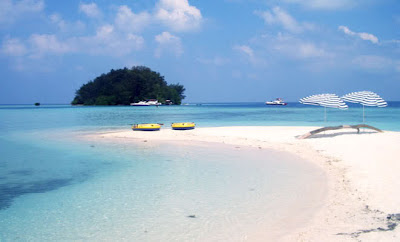
Today, it takes some digging to discover Pulau Macan, one of the 110 terrestrial oases that make up the Pulau Seribu (Thousand Islands) north of Jakarta — but that could change in the future. I found Pulau Macan by happenstance, seeking an alternative when a visit the Gili Islands turned out to be too expensive for a weekend trip. But what began as a budget-conscious consolation prize proved to be a first-rate vacation all its own.
A Good Start
![]() |
| Tiger Island (Pulau Macan) |
Our trip out was speedy and smooth, though the return, on a much smaller boat, was quite bumpy.
Rough seas notwithstanding, the boat trip can be just as enjoyable as island time, the trash-strewn waters of Jakarta turning to infinite ocean, which suddenly lightens from indigo to azure as emerald islands appear on the horizon.
![]() |
| Tiger Island (Pulau Macan) |
Sleeping accommodations are comfortable across the board, though I’d advise turning in on the early side, since the mornings bring dazzling sunlight along with rooster crows, songbird trills and the noisy activities of early-rising guests.
Dive Right In
With a tropical playground to explore, I made sure to be well-rested. The primary island pursuit is snorkeling. Pulau Macan supplies masks, flippers and water booties, so there was no excuse not to give it a try. With masks strapped on, we waded out into the sun-warmed water (Beware the small beige fish near shore — they bite! Painless but a bit startling), and let ourselves tune out everything above sea level.
![]() |
| Under water at Tiger Island (Pulau Macan) |
Staying close to the island provides a wonderful snorkeling experience. But, feeling more adventurous, we decided to swim out until the crystal shallows dropped off into dark blue depths. These ridges, with massive islands of coral marking the underwater cliff, provided an endless supply of sea life to witness.
Following the curve of the ridge away from the island, we soon reached The Deserted Island, an undeveloped sanctuary owned by the resort, which offered solitude, quiet and exquisitely exhaust-free air.
![]() |
| Under water at Tiger Island (Pulau Macan) |
Back on the Island
We found land activities to be available, but limited. The clubhouse provides board games and a billiard table (there is only one stick, so be ready to share), plus there was a beach volleyball net and an on-site masseuse.
The masseuse, perched by his spa hut at all hours awaiting customers, is perhaps the least discovered aspect of a largely undiscovered island. For only Rp 150,000 ($16) for an hourlong massage in an idyllic stilted hut overlooking sparkling ocean, I couldn’t fathom that only two guests, myself included, signed up for the service. Of course, that could have been related to our host’s description of the masseuse during the tour: “He’s rather blind, rather deaf and tends to be quite rough.” I did find the massage a bit on the forceful side, but that was an invigorating juxtaposition to the storybook tranquility of the setting. And if I wanted less intensity, I only had to touch his hand and he lightened up.
With all that relaxing, I worked up an appetite, easily sated by Pulau Macan’s all-you-can-eat dining program. Expect seasonal fruit at breakfast, and a wide selection, including vegetarian-friendly options, at lunch and dinner, plus platters of hors d’oeuvres that materialize on the sundeck each evening near twilight.
![]() |
| Tiger Island (Pulau Macan) |
Perhaps the best part of meals at Pulau Macan was their communal aspect. You can request to eat apart from the group, but I recommend taking full advantage of this excuse for companionship. It’s an invaluable opportunity to meet people you might never have encountered otherwise, people from wide-ranging cultural, geographic and educational backgrounds, people with rich stories and open minds. At minimum, these communal meals allow you to witness the myriad paths a human life can take, and at best, you might meet someone whose friendship weathers the bumpy trip back to Java and becomes a mainland ally.
Back to Basics
Pulau Macan is not a luxury resort, but it doesn’t pretend to be. In fact, it’s the quirks — the hole-ridden water shoes, the tied-together snorkeling masks, the uneven rowboat oars — that create its comfort. Pretense yields to authenticity, conveniences give way to community, and you find yourself luxuriating in the modesty of an unheated shower, grateful that your BlackBerry’s reception is too spotty to be useful. There is a simplicity that most of us long ago drowned out with the noise of modern life.
![]() |
| Tiger Island (Pulau Macan) |
Kate Willsky for Jakarta Globe
Friday, June 1, 2012
Post-game Chaos Between Fans of Persija and Persib Video on Youtube
![]() |
| Rangga Cipta Nugraha: (Tribunnews.com) |
In the five-minute video, uploaded by YouTube user battlehorse123, a group of men wearing the regalia of Persija fans, nicknamed Jakmania, is seen assaulting a male spectator wearing a white t-shirt and blue jeans.
The man, allegedly one of the fans of Persib, widely known as Viking, appears to be unconscious after the beating before he is dragged outside the soccer stadium by what seem to be fans of Persija.
Some police officers are also seen in the video, but make little effort to stop the fight.
Three men died in brawls between the fans of the two rival clubs after Sunday’s game, which resulted in a 2-2 tie.
The victims were identified as Rangga Cipta Nugraha, Dani Maulana and Lazuardi.
Meanwhile, several people claiming to be the perpetrators of the beating have been appearing via various social media sites such as Facebook and Kaskus.com. The latter is Indonesia’s largest online community.
Through their online accounts, the self-proclaimed perpetrators insist that they would not mind being imprisoned as long as they “could kill the fans of Persib”, tribunnews.com reported.
To see the Youtube video, click here: http://www.youtube.com/watch?v=Zm2nREbstNs
Indonesia to Move to Single Time Zone
The change will put Indonesia, the world’s largest shipper of thermal coal and tin, eight hours ahead of Greenwich Mean Time, according to the ministry. The country that stretches about 5,300 kilometers (3,294 miles) and borders India in the west and Australia in the east, has three time zones.
The move will help accelerate economic development across the country, Trade Minister Gita Wirjawan said in the statement in Jakarta. After the change in clocks, the country’s stock market will open 30 minutes after bourses in Singapore and Malaysia, from 90 minutes at present.
“The benefit will be in synchronized trade and financial transactions with regional markets,” Anton Gunawan, chief economist at Bank Danamon Indonesia, said The Jakarta Globe Quote by phone on Wednesday. Still, the switch “requires work and there’s the cost impact, not to mention the disorder that may ensue. The benefit isn’t that evident compared with the cost that comes with it.”
Jakarta’s clocks are two hours behind cities in eastern Indonesia. A unified time zone will help improve communication and productivity of Indonesia’s bureaucracy and help the spread of information through medium such as television broadcasts, Wirjawan said.
Car Thief Suspect Flees With Malaysian Police Motorcycle
![]() |
| DLM police motorcycle illustration |
Police pulled over the man in the northern state of Penang on Wednesday as he drove a BMW that was suspected to have been stolen, the New Straits Times reported.
Police asked the man to step out of the car, but while they were inspecting the vehicle, he jumped on one of the police motorcycles.
Police gave chase but he managed to give them the slip.
Police officials could not immediately be reached for more details on the case.
Agence France-Presse
Subscribe to:
Posts (Atom)