Friday, June 13, 2014

Flight MH370 Families Receiving $50,000 in First Payouts

A woman, left, whose son, daughter-in-law and grandson were aboard the missing Malaysia Airlines flight MH370, cries after she and other family members failed to express their appeals to the airline outside its office in Beijing on June 11, 2014. Malaysia Airlines’ insurer has begun paying the families of passengers onboard flight MH370 $50,000 each in initial compensation three months after the jet disappeared. (Reuters Photo/Jason Lee)
Kuala Lumpur. Malaysia Airlines’ insurer has begun paying the families of passengers on board flight MH370 $50,000 each in initial compensation three months after the jet disappeared, a government official said on Thursday.

So far six Malaysian and one Chinese family have received the advance payment, to which all the families of the 239 passengers and crew on board are entitled, said Malaysian deputy foreign minister Hamzah Zainudin.

Talks with 40 more Chinese families are underway to ascertain they are the rightful claimants, said Hamzah, who heads a committee to support the missing passengers’ next-of-kin.

The Boeing 777 inexplicably disappeared on March 8 en route from Kuala Lumpur to Beijing, with no sign of wreckage found despite an extensive search off western Australia.

Full payment to the families — who can claim up to more than three times the amount of the initial payout — would be made later, Hamzah said.

The government was not yet prepared to declare the plane lost, he added.

“When we talk about the full payment, we have to wait until we announce the issue on the tragedy MH370 is over … whether the plane is found, whether we announce the plane is lost,” he said.

Passengers’ families can claim up to about $175,000 under International Civil Aviation Organization rules, regardless of fault, in a plane crash.

Malaysia Airlines’ insurer, a consortium led by Germany’s Allianz, is making the payments.

Malaysia and Australia have promised they will not give up looking for the plane in a vast deep-sea area in the southern Indian Ocean where the jet is believed to have crashed, based on satellite data.

But angry relatives of some of those on board have accused Malaysia and its national carrier of reacting too slowly and covering up information. Two-thirds of the passengers were Chinese.

A handful of families on Sunday launched an online campaign to raise $5 million to reward a “whistleblower” who comes forward with information to help find the plane.

So far, they have raised more than $25,000.

“The government has been very transparent from day one,” said Hamzah on Thursday.

The next phase of the hunt will see authorities comb a 60,000 square-kilometer search zone based on the plane’s last satellite communication.
Agence France-Presse

Thursday, May 22, 2014

Air Force Soldier Allegedly Assaults 11-Year-Old Schoolboy

Illustration Picture by Okezone.com
The father of an 11-year-old sixth-grade student at SD Santo Markus I private junior high school in East Jakarta named Putri allegedly assaulted one of his daughter’s classmates, Dwi Novriadi.
Putri’s father is a lieutenant colonel in the Indonesian Air Force (TNI-AU).

According to Dwi, 11, the incident took place a month ago in front of the school’s gates after several of Dwi’s friends playfully mocked Putri as her brother had the same name as noted dangdut singer Rhoma Irama’s son, Ridho Roma.

“I was in front of the school with four friends. My friends were teasing Putri before her father came to pick her up,” Dwi said as quoted by Warta Kota daily.

Dwi’s friends then fled when they saw Putri’s father arrive, leaving him alone.

Putri then ran to her father, who called to Dwi to approach his car. He complied, only to be hit in the face by Putri’s father, causing his upper lip to bleed.

Dwi said he felt wronged because he maintained that he had not joined his friends in mocking Putri.
“After hitting me, Putri’s father asked me if I had mocked her. I said no, but he told me to be quiet. After they left, I reported the incident to the school principal,” he said.

According to the school’s principal, Damianus Puji, the school arrange a mediation session between Dwi and Putri’s parents, which was held one week after the attack.

During the meeting, Putri’s father attempted to clarify what had happened during his exchange with Dwi and apologized to the boy’s parents, Puji said.

However, Dwi said that he had never received a personal apology from Putri’s father, adding that her father had shouted at him on several occasions since the incident took place.

After hitting an impasse in the mediation, Dwi’s parents then reported the assault to the East Jakarta Police and the Indonesian Child Protection Commission (KPAI), according to Puji.

East Jakarta Police spokeswoman Adj. Comr. Etty Wiyandari confirmed that the case had been reported to them, adding that the matter was under investigation.

“Dwi’s parents filed the report a week after the incident. We are planning to hand the case over to the military police,” Etty said as quoted by tempo.co.

Meanwhile, KPAI commissioner Susanto confirmed that the commission had also received a report and was currently studying the details.

“If the allegation is true, then the perpetrator has violated the Child Protection Law. We will fight for Dwi’s rights,” Susanto told The Jakarta Post on Wednesday.

“No one is above the law; that includes state officials and military personnel,” he concluded. The Jakarta Post

Wednesday, May 21, 2014

Fossils of 'Largest' Dinosaur Found in Argentina

Giant dinosaur: Handout picture released on Saturday by the Egidio Feruglio Paleontological Museum showing technicians working in the area where fossils of a dinosaur -- likely to be the largest ever to roam the earth-- were found in Chubut, some 1,300 kilometers (800 miles) south of Buenos Aires. Paleontologists in Argentina's remote Patagonia region have discovered fossils of a creature is believed to be a new species of Titanosaur, a long-necked, long-tailed sauropod that walked on four legs and lived some 95 million years ago in the Cretaceous Period. (AFP/Museo Egidio Feruglio)
Paleontologists in Argentina's remote Patagonia region have discovered fossils of what may be the largest dinosaur ever, amid a vast cache of fossils that could shed light on prehistoric life.

The creature is believed to be a new species of Titanosaur, a long-necked, long-tailed sauropod that walked on four legs and lived some 90 million years ago in the Cretaceous Period.

Researchers say the plant-eating dinosaur weighed the equivalent of more than 14 African elephants, or about 100 tonnes, and stretched up to 40 meters (130 feet) in length.

The previous record holder, also in Argentina, the Argentinosaurus, was estimated to measure 36.6 meters long.

A fossilized femur of the Titanosaur was larger than a paleontologist who lay next to it.
And the find didn't stop there.

Bones from at least seven individual dinosaurs, including some believed to be younger, were found at the site.

This is "the most complete discovery of this type of giant dinosaur in the world, a momentous discovery for science," cheered Jose Luis Carballido, one of eight scientists who participated in the research.

The fossils were accidentally discovered in 2011 by a farm worker in a remote area in the Patagonian province of Chubut, some 1,300 kilometers (800 miles) south of Buenos Aires.

The worker first spotted a massive leg bone, measuring some 2.4 meters in length.

Excavations launched in January 2013 also uncovered complete bones of the tail, torso and neck -- which will allow for a fuller picture of what the entire animal looked like when alive.

Carballido, part of a team of Argentine and Spanish researchers, said the group had uncovered "10 vertebrae of the torso, 40 from the tail, parts of the neck and complete legs."

"Until now, what was known, worldwide, about sauropods was from fragmentary discoveries," said the 36-year-old paleontologist from the Egidio Feruglio Museum in the southern city of Trelew, calling the find "extraordinary."

- Tip of the iceberg -

Even more bones may yet appear.

So far, "we have only recovered an estimated 20 percent of what's in the field," said Carballido.

The find is set to help shed light on more than just the anatomy of these remarkably large herbivores.

The researchers have also found what they believe to be muscle insertions, which will help them reconstruct the form of the creature's muscles and calculate how much energy was needed to move them.

Paleontologists have found about 60 teeth at the site, 57 of which are from Tyrannotitan carnivores -- one of the largest known therapods, and known scavengers.

In addition to the skeletal remains, fossil imprints of leaves and stems have been found, which could help researchers rebuild the ecosystem at the time.

"We will be able to make a very precise reconstruction and answer many questions," Carballido said -- including just what about southern Argentina made conditions favorable for so many massive dinosaur species.

- 'A treasure trove' -

So far, the new species remains unnamed, and scientists estimate they will publish the first results next year.

"The research will be done in several stages. First we will present the new species, its characteristics," Carballido said, followed by years of study to detail the animal's biology and "the way it grew up."

Paul Barrett, fossils and anthropology expert at London's Natural History Museum, cautioned that claims this dinosaur is the largest ever still must be confirmed.

"This is an inspiring new discovery of a truly gigantic dinosaur," Barrett said.

"However, we need to know more about the overall size and proportions of the skeleton and use several different methods to investigate its possible width before deciding it's definitely the largest dinosaur species yet known."

US paleontologist David Burnham agreed that "a lot of things still need to be proven."

But largest dinosaur or not, the breadth of the discovery was truly remarkable.

"You can really start reconstructing past life when you get a treasure trove like this," said Burnham, of the University of Kansas.

Finding so many individual dinosaurs at one site could confirm the hypothesis that these herbivores lived in herds, as well as determine any predators they may have had, whether they were scavengers, when they died and in what type of environment they lived, the paleontologist added. AFP

Monday, May 19, 2014

A First for Indonesia, Ethnic Chinese Leader Takes Charge in the Capital

Jakarta Deputy Governor Basuki Tjahaja Purnama. (JG Photo/ Afriadi Hikmal)
Indonesia’s presidential race isn’t until July. But there’s already one winner.

Basuki Tjahaja Purnama has taken over as acting governor of Jakarta, the first ethnic Chinese to do so.

A Christian, Basuki succeeds Joko Widodo who has stepped aside to run for the presidential election on July 9, which opinion polls suggest he will win. Basuki will automatically take over to complete Joko’s five-year term if he does win.

Indonesia’s Chinese make up only about 2 percent of the 240 million population.

Resented for their wide control over trade and business, and suspected of loyalty to China, Indonesian-Chinese have been deliberately kept out of the political and military hierarchy for most of the country’s almost 70 years of independence.

The resentment, which has burst into bloody riots in the past, appears to be on the wane, although it’s not over.

Even critics of Jakarta’s acting governor complain mostly about what they see as his abrasive style of governance, not his background.

“People are voting for a track record today,” Basuki told Reuters in an interview in his office in April. “It’s not about the race or religion…or some primordial idea of who should run [the country].”

Bad cop
Basuki has been the bad cop to Joko’s good cop. In contrast to the typically soft-spoken and Javanese Joko, Basuki has gained a reputation for being a tough guy not afraid to shake up the city’s sleepy bureaucracy.

“The first thing we have to fix here is the bureaucracy…by testing and evaluating their performance,” Basuki said.

“We say to them if they don’t want to follow us, they can get out. Sometimes we have to kick them out. Of course they are angry but we don’t care.”

Basuki, 48, has served as Joko’s right-hand man since winning the 2012 Jakarta gubernatorial election when the pair toppled the incumbent with their can-do, transparent ideas on fixing the many problems of the chaotic city, including chronic traffic and flooding.

“I personally don’t agree [with Basuki becoming governor] because he’s too temperamental,” city councilor Boy Bernardi Sadikin told media.

Sadikin is the son of a former Jakarta governor from the 1970s, who many residents believe was the last popular and effective leader the city saw before Joko and Basuki.

Videos of Basuki losing his temper with inefficient bureaucrats have gone viral in Indonesia but the public has been largely supportive of the acting governor’s no-nonsense style in a country bedeviled by corruption and bureaucratic inertia.

When running in the 2012 Jakarta election, Basuki, who is from the resource-rich Bangka Belitung province, faced smear campaigns from rivals.

But the at times blatant racist attacks had little effect and Jakarta residents voted in favor of Joko and Basuki with a 55 percent majority.

Indonesia, the world’s third largest democracy, has a history of communal tensions that have at times boiled over into violent attacks specifically targeting the ethnic Chinese minority.

The country saw one of the most horrific attacks on the Chinese community in 1998 as Indonesia descended into political and economic chaos following the Asian financial crisis. Rampaging mobs targeted

Chinese-owned businesses and in some cases killed and raped Chinese-Indonesians, forcing hundreds to flee the country.

Hardline Muslim groups, who last year protested the appointment of a Christian woman to a Jakarta district office, have also threatened to protest Basuki’s rise to power.

But Basuki believes Indonesia is becoming more pluralist.

“The Jakarta election was a test and…we see more ethnic Chinese running for [public office] now,” Basuki said. “One day soon Indonesia will be ready for a non-Muslim or ethnic Chinese leader, even president.” 

Reuters

Friday, May 16, 2014

Virtual Museum Brings Indonesia’s Heritage Closer to Home

Another world: A man (above) looks at ancient statues through Occulus Rift glasses. The virtual reality glasses contain digital representations of statues of Hinamari (left) and an elephant and rider (right). (JP/Hans David Tampubolon)
Anantarupa Studios introduced last week the nation’s first virtual reality museum, aiming bring to Indonesians parts of Indonesia’s ancient heritage that have been scattered to museums throughout the world.

The museum, which uses Oculus Rift virtual reality technology recently purchased by Facebook, will open to the public until May 18 during the Museum Week event at the Senayan City mall in Senayan, South Jakarta.

After the event ends, the collection will have a permanent home at Gallery Indonesia in the Grand Indonesia shopping center in Sudirman, Central Jakarta, starting mid-June.

The museum currently features 10 ancient statues from the era of the Majapahit, an ancient archipelagic empire which ruled parts of present day Brunei, Indonesia, Malaysia, the Philippines, Singapore, Thailand and Timor Leste.

The original pieces are located in various museums all over the world.

The virtual Adityawarman statue on display at the exhibition, for example, was modeled after the original, which currently resides at the Tropen Museum in Amsterdam, The Netherlands.

There are also models of a Dwarapala statue from the Asian Art Museum in San Francisco, the US; and a Sri Rajadevi Maharajasa statue from the Victoria and Albert Museum in England.

Anantarupa uses the Oculus Rift 3D goggles as a medium to take visitors into the realm of virtual reality.

The goggles use a seven-inch LCD display, visible via dual lenses that are positioned over the eyes. This provides stereoscopic 3D vision for users, who can freely move their heads from side to side, making the experience as close to real life as possible.

Using the goggles, users can start their visit by looking at the Majapahit sun emblem at the center of the display. After it finishes spinning, users can access see the historical details of each statue, such as the year it was made or the philosophy behind its creation - all simply by glancing at the statue.

To provide an immersive experience, the virtual museum also provides audio commentary to explain the historical background of each statue when a user looks at it.

There are, however, still some real life elements missing.

For example, the goggles cannot detect when users move their heads forward to look at the statue up close. Nor could users look at the statues from all angles.

Anantarupa managing director Diana Paskarina attributed some of the glitches to the accelerated digitization process, which took one month, as opposed to the three months that are typically required.

“We were invited to participate in the Museum Week event, so we decided to complete the 3D modeling sooner than our original schedule, which was to be the end of this year,” Diana said.

Gaining direct access to the statues was also tough.

“The most challenging part of creating the virtual museum was the research, because we often could not visit the museums that were located abroad to see how the statues look in real life,” Diana said.

To cope with the challenge of digitizing remote statues, Diana said that they relied on the Internet for photographs to make 3D models. “Sometimes, we can only see the front and the side parts of the statues. Therefore, as you can see, some statues are incomplete, especially in the back.”

Diana said users could expect more and better visualizations in the future.

“We plan to add 58 statues in total from the Majapahit era,” she said, adding that she hoped the project would emphasize museums as windows to the past and attract sponsors to finance expansion.

“We’re using Oculus technology to lure more people to become interested in museums,” Diana said. “By using virtual reality and technological interactivity, we hope people can see museums from a different perspective and eventually lure them to visit museums in real life as well.” The  Jakarta Post

Tuesday, May 13, 2014

BlackBerry Fights Back With Budget Indonesian Smartphone

A man silhouetted against a video screen displaying the the Blackberry logo as he poses with a Blackberry Q10 in the central Bosnian town of Zenica in this September 21, 2013 file photo illustration. (Reuters Photo)
Jakarta. BlackBerry on Tuesday launched a new budget handset in Indonesia, one of its last bastions, a major step in the ailing smartphone maker’s fight back against titans Samsung and Apple.

The Z3, designed with Indonesia in mind but expected to be introduced in other emerging markets later, is the first new BlackBerry phone since chief executive John Chen took the helm of the crisis-hit company in November.

The handset is also the first to be produced from the Canadian firm’s partnership with Taiwanese tech giant Foxconn, which makes gadgets for Apple, and is a key test of whether the new strategy will work.

BlackBerry believes the Indonesian model — whose full name is the Z3 “Jakarta Edition” — will be a hit in
Southeast Asia’s biggest economy, where the company maintains a loyal following despite losing ground in recent years, thanks in part to the popularity of its BBM messaging service.

Like many other global companies, BlackBerry is also targeting Indonesia due to its huge population of 250 million and its rapidly emerging middle class, who increasingly have cash to spend on gadgets following years of sustained economic growth.

“From conception to delivery, the BlackBerry Z3, Jakarta Edition, was designed specifically with our
Indonesian customers in mind,” Chen said during a visit to the Indonesian capital to launch the phone.

The phone will be available in shops from Thursday and will cost 2,199,000 rupiah ($190), BlackBerry said in a statement.

But analysts think it is already too late for a comeback by the company that pioneered the modern smartphone culture but has been unable to keep up with competition from Apple’s iPhone and handsets using the Google Android operating system.

Recent years have been dismal for BlackBerry, and it has suffered heavy losses and slashed thousands of jobs.

The company even put itself up for sale last year but abandoned hopes of finding a buyer several months later, and ousted chief executive Thorsten Heins.

Since Chen took over, there have been small signs of improvement. The company reported a loss of $423 million in the three months to March 1, which was not as bad as had been feared.

As part of its turnaround strategy, the smartphone maker announced the tie-up with Foxconn in December.

It involves transferring manufacturing and inventory management to the Taiwanese company, while allowing BlackBerry to focus on software and services.

The Z3 has a 13 centimeter touchscreen, without the physical keyboard of the older devices.

The Jakarta Edition’s BBM messaging service comes loaded with pictures of local cartoon characters for users to send to one another.

There is also a limited edition with the inscription “Jakarta” on the back.

BlackBerry’s most recent phones have not fared well in Indonesia but the company believes the Z3 will be popular, in particular due to its lower price.

Retailers say that online pre-orders, which began on April 28, have been healthy.

BlackBerry has refused to say which emerging markets it might take the phone to next, but analysts speculated it would likely be others in Southeast Asia.

But even the picture in Indonesia, one of the company’s healthiest markets, is increasingly dire and the Z3 may be too little too late, analysts warn.

“The launch of this device is really BlackBerry’s final stand in the Indonesian market,” Sudev Bangah from telecoms consultancy IDC told AFP.

IDC says BlackBerry’s market share peaked in Indonesia in 2011 at about 43 percent and remained healthy in 2012, only to suffer a collapse in 2013 when it slumped to around five percent in the final quarter, in the face of stiff competition from Samsung in particular.

Agence France-Presse

Monday, May 12, 2014

BlackBerry Steps Up Fightback With Indonesian Phone

A file photo dated 13 December 2011 showing an Indonesian salesgirl serving a customer as a poster of various kind of BlackBerry is seen on the background at a shopping mall in Jakarta, Indonesia. (EPA/Mast Irham)
Jakarta. BlackBerry will this week launch a new budget handset in Indonesia, one of its last bastions, a major step in the ailing smartphone maker’s fightback against titans Samsung and Apple.

The Z3, which is designed for Indonesia but will likely be introduced in other emerging markets later, is the first new BlackBerry phone since chief executive John Chen took the helm of the crisis-hit company in November.

The handset is also the first to be produced from the Canadian firm’s partnership with Taiwanese tech giant Foxconn, which makes gadgets for Apple, and is a key test of whether the new strategy will work.

The company believes the device will be a hit in Indonesia, where many have remained loyal to BlackBerry, with a spokesman saying that “this product will deliver something that? should resonate with consumers”.

But analysts believe it may already be too late for a comeback by the company that pioneered modern smartphone culture but has been unable to keep up with competition from Apple’s iPhone and handsets using the Google Android operating system.

Recent years have been dismal for BlackBerry, and it has suffered heavy losses and slashed thousands of jobs.

The company even put itself up for sale last year but abandoned hopes of finding a buyer several months later, and ousted chief executive Thorsten Heins.

Since Chen took over, there have been small signs of improvement. The company reported a loss of $423 million in the three months to March 1, which was not as bad as had been feared.

As part of its turnaround strategy, the smartphone maker announced the tie-up with Foxconn in December, which involves transferring to the Taiwan company manufacturing and inventory management, while allowing BlackBerry to focus on software and services.

BlackBerry has chosen to launch its first new phone from the partnership in Indonesia, Southeast Asia’s biggest economy with legions of social media-mad young consumers, where its devices remain popular but it has nevertheless lost ground in recent years.

Low retail price
The phone has a 13 centimeter touchscreen, like most of BlackBerry’s newest handsets which do not have the physical keyboards of the older devices.

It is designed specifically with Indonesian consumers in mind. The BBM messaging service — wildly popular in Indonesia — comes loaded with pictures of local cartoon characters for users to send to one another.

There is also a limited edition with “Jakarta” engraved on it.

BlackBerry believes the low price — it will retail for around $200 — will be a particular selling point.
Previous phones released on the new BlackBerry 10 operating system in Indonesia were more expensive, such as the Z10 which sold for around $700, and received only a lukewarm response.

Online pre-orders, which began on April 28, have been healthy, according to retailers.
“The response is positive and hundreds of units were sold in less than a week after the pre-order started,” said an employee at vendor Global Teleshop, who declined to be identified.

The phone will be launched on Tuesday in Jakarta and will go on sale in the following days.
BlackBerry has refused to say which emerging markets it might take the phone to next, but analysts speculated it would likely be others in Southeast Asia.

But even the picture in Indonesia, one of the company’s healthiest markets, is increasingly dire and the Z3 may be too little too late, analysts warn.

“The launch of this device is really BlackBerry’s final stand in the Indonesian market,” Sudev Bangah from telecoms consultancy IDC told AFP.

IDC says BlackBerry’s market share peaked in Indonesia in 2011 at about 43 percent and remained healthy in 2012 only to suffer a collapse in 2013, when it fell to around 13 percent.

And Bangah said it was unlikely the new device would be BlackBerry’s savior in Indonesia.
“Do we expect a mass exodus to this device? Hardly likely,” he said, adding IDC expected BlackBerry’s market share to fall to around 10 percent this year.
Agence France-Presse

Friday, September 20, 2013

Oct. 23, Indonesia RED vs United RED at Gelora Bung Karno

Battle of RED (Retired Extremely Dangerous) is a grand event among famous football legend players England Premier League especially the big club from Manchester, England.

Legendary players are now unifies as United RED. They will travel to Indonesia for carry out a series of events which aims to celebrate the spirit of sport through friendly matches.

The series of events starts with Coaching Clinic, Gala Dinner, Signing Session and ends with Friendly Match is open to the public at Indonesia National Stadium Gelora Bung Karno on Oct. 23. This match will be the first time the United RED players competed in Indonesia as a team.

Battle of RED will be an opportunity for fans of football sports especially for England Premier League fans be able to meet directly with their idol and watch the Indonesian legend team compete against world football star with the appearance of quality football.

Come and join forces to provide support to your favorite team. Keep turn the RED light and keep the spirit of “Battle of the RED”

The Legends are Coming

Michael Owen, Paul Parker and Louis Saha
  1. Michael Owen
  2. Quinton Fortune
  3. Louis Saha
  4. Paul Parker
  5. Ronnie Johnsen
  6. David May
  7. Lee Sharpe
  8. Clayton Blackmore
  9. Jesper Blomqvist
  10. Keith Gillespie
  11. Ben thornley
  12. Lee Martin
  13. Russell Beardsmore
  14. Nick Culkin
And many more…

Indonesia RED Squad

Ind-Red
Kurniawan Dwi Yulianto, Firman Utina and Bambang Pamungkas
  1. Hendro Kartiko
  2. Kurnia Sandi
  3. Ismed Sofyan
  4. Maman Abdurrahman
  5. Isnan Ali
  6. Charis Julianto
  7. Bejo Sugiantoro
  8. Erol FX Iba
  9. Bima Sakti
  10. Ponaryo Astaman
  11. Firman Utina
  12. M. Ridwan
  13. Budi Sudarsono
  14. Anang Ma’ruf
  15. Bambang Pamungkas
  16. Kurniawan Dwi Yulianto
  17. Gendut Doni
  18. Zaenal Arif
Tiket Available 

MAP Battle of RED

GBK MAP Battle of RED

Wednesday, September 11, 2013

Indonesia RED vs Manchester United Legends at Gelora Bung Karno Stadium on Oct. 23

Indonesia RED vs Manchester United Legends press conference at The Cone, FX Sudirman, Friday (6/9)

Jakarta, JG: A clutch of Manchester United former greats will fly into Jakarta on Oct. 23 for an exhibition match against a team of Indonesian players at the national stadium.

“Peter Schmeichel will be the team manager,” said R. Sasikumar, a managing director at Red Card, the agency that will organize the MU visit. “We are also still in talks with Paul Scholes. In total, we have 14 players but we will announce the full squad shortly.”

Former greats such as Dwight Yorke, Ronny Johnsen and Jesper Blomqvist will be on the teamsheet taking on Indonesia’s RED, which apparently stands for “Retired Extremely Dangerous,” in a friendly match the promoter is calling the “Battle of RED” at Gelora Bung Karno Stadium.

Local favorites such as Bambang Pamungkas will represent Indonesia in the match, which will begin at 7 p.m. and will be aired on MNCTV.

“We all know MU has a big fan base in Indonesia,” Sasikumar said. “You have 50 million fans here. It makes sense that they come to Indonesia. The team will visit Singapore and Macau as well.”

Event promoter Franky Paath of MC Pro Enterprise said that the players’ visit would bring back memories of their golden era.

“I also hope young Indonesian players get to experience their performance against the retired Indonesians,” he said.

Abdul Hakam Ikromi, a 24-year-old MU fan, said he was excited for the visit.

“We are enthusiastic about watching them live,” he said. “Though the current squad still can’t visit Indonesia, we are delighted to have the legends here in Jakarta. I hope the current team will visit soon… as big fans of MU, we are ready to convince them that it is safe to play in Indonesia.”

Tickets are available from Rp 50,000. Local brand JJ Royal Coffee has signed on as the primary sponsor and will give away 5,000 free tickets. JG

Wednesday, July 17, 2013

A Tribute To Michael Jackson Live In Concert

MJ


YOU HAVE SEEN IMPERSONATE QUEEN, YOU HAVE SEEN IMPERSONATE BEE GEES, BUT THIS ONE IS DIFFERENT,

MICHAEL JACKSON IMPERSONATE NO 1 IN THE WORLD direct from LAS VEGAS TO INDONESIA for Tour Concert 

KENNY WIZZ

HISTORY….does repeat itself and this world class show is the ultimate tribute to Michael Jackson. Celebrate the music, the magic and all the HIStory. This is the closed you will ever get to sseing the King Of Pop in Concert

This Musical biography will take you back to the Jackson Five and then on the thrilling journey as hit after hit tells the story of the one of the greatest pop icons the world has everknow.

All performed LIVE by Kenny !

Surabaya 31 August 2013

Event Date : 31 August 2013 - 20:00
VENUE        : JATIM Expo, Jatim Expo International Jl. Ahmad Yani No 99 – Surabaya Jawa Timur – Indonesia 

Makasar 02 September 2013

Event Date : 02 September 2013 - 20:00
VENUE        : Phinisi Ballroom, Grand Clarion Hotel Makasar, Grand Clarion Hotel & Convention Jalan A.P. Pettarani No.3 Makasar

Balikpapan 04 September 2013

Event Date : 04 September 2013 - 20:00
VENUE        : Grand Clarion Hotel Makasar Jalan Ruhui Rahayu

Jakarta 07 September 2013

Event Date : 7 September 2013 – 17:00
VENUE        : SKENOO, Gandaria City Mall 3 flr Jl. Sultan Iskandar Muda No. 57A Arteri Pondok Indah Kebayoran Lama

Event Date : 7 September 2013 – 21:00
VENUE        : SKENOO, Gandaria City Mall 3 flr Jl. Sultan Iskandar Muda No. 57A Arteri Pondok Indah Kebayoran Lama

Ticket Pre-Sale Information

Where To Buy The Ticket

Kenny Wizz Tribute to Michael Jackson ticket information,
please contact our ticket box at

Our ticket box:

Find ticket information at www.mybooking.co.id
 

Tuesday, May 21, 2013

Vast Oklahoma Tornado Kills at Least 91

Rescue workers searched the remains of Plaza Towers Elementary School through Monday night.
Rescue workers searched the remains of Plaza Towers Elementary School through Monday night. By NICK OXFORD and MICHAEL SCHWIRTZ
MOORE, Okla. — A giant tornado, a mile wide or more, killed at least 91 people, 20 of them children, as it tore across parts of Oklahoma City and its suburbs Monday afternoon, flattening homes, flinging cars through the air and crushing at least two schools.

The injured flooded into hospitals, and the authorities said many people remained trapped, even as rescue workers struggled to make their way through debris-clogged streets to the devastated suburb of Moore, where much of the damage occurred.

Amy Elliott, the spokeswoman for the Oklahoma City medical examiner, said at least 91 people had died, including the children, and officials said that toll was likely to climb. Hospitals reported at least 145 people injured, 70 of them children.

Plaza Towers Elementary School in Moore was reduced to a pile of twisted metal and toppled walls. Rescue workers were able to pull several children from the rubble, but on Monday evening crews were still struggling to cut through fallen beams and clear debris amid reports that dozens of students were trapped. At

Briarwood Elementary School in Oklahoma City, on the border with Moore, cars were thrown through the facade and the roof was torn off.

“Numerous neighborhoods were completely leveled,” Sgt. Gary Knight of the Oklahoma City Police Department said by telephone. “Neighborhoods just wiped clean.”

He said debris and damage to roadways, along with heavy traffic, were hindering emergency responders as they raced to the affected areas.

A spokeswoman for the mayor’s office in Moore said emergency workers were struggling to assess the damage.

“Please send us your prayers,” she said.

Brooke Cayot, a spokeswoman for Integris Southwest Medical Center in Oklahoma City, said 58 patients had come in by about 9 p.m. An additional 85 were being treated at Oklahoma University Medical Center in Oklahoma City.

“They’ve been coming in minute by minute,” Ms. Cayot said.

The tornado touched down at 2:56 p.m., 16 minutes after the first warning went out, and traveled for 20 miles, said Keli Pirtle, a spokeswoman for the National Weather Service in Norman, Okla. It was on the ground for 40 minutes, she said. It struck the town of Newcastle and traveled about 10 miles to Moore, a populous suburb of Oklahoma City.

Ms. Pirtle said preliminary data suggested that it was a Category 4 tornado on the Enhanced Fujita scale, which measures tornado strength on a scale of 0 to 5. A definitive assessment will not be available until Tuesday, she said.

Moore was the scene of another huge tornado, in May 1999, in which winds reached record speeds of 302 m.p.h., and experts said severe weather was common in the region this time of year.

But the region has rarely had a tornado as big and as powerful as the one on Monday.

Television on Monday showed destruction spread over a vast area, with blocks upon blocks of homes and businesses destroyed. Residents, some partly clothed and apparently caught by surprise, were shown picking through rubble. Several structures were on fire, and cars had been tossed around, flipped over and stacked on top of each other. Kelcy Trowbridge, her husband and their three young children piled into their neighbor’s cellar just outside of Moore and huddled together for about five minutes, wrapped under a blanket as the tornado screamed above them, debris smashing against the cellar door.

They emerged to find their home flattened and the family car resting upside down a few houses away. Ms. Trowbridge’s husband rushed toward what was left of their home and began sifting through the debris, then stopped, and told her to call the police.

He had found the body of a little girl, about 2 or 3 years old, she said.
“He knew she was already gone,” Ms. Trowbridge said. “When the police got there, he just bawled.”

She said: “My neighborhood is gone. It’s flattened. Demolished. The street is gone. The next block over, it’s in pieces.”

Sarah Johnson was forced to rush from her home in Moore to the hospital as the storm raged when her 4-year-old daughter, Shellbie, suffered an asthma attack. With hail raining down, she put a hard hat on her daughter as she raced into the emergency room and hunkered down.

“We knew it was coming — all the nurses were down on the ground so we got down on the ground,” Ms. Johnson said from the Journey Church in nearby Norman, where she had sought shelter.

At the hospital, she said, she shoved her daughter next to a wall and threw a mattress on top of her. After the storm passed, debris and medical equipment were scattered around, she said.

Ms., Johnson said she and her daughter were safe, but she had yet to find her husband.

The storm system continued to churn through the region on Monday afternoon, and forecasters warned that new tornadoes could form.

An earlier storm system spawned several tornadoes across Oklahoma on Sunday. Several deaths were reported.

Russell Schneider, the director of the National Oceanic and Atmospheric Administration’s Storm Prediction Center in Norman, said the risk of tornadoes throughout the region remained high going into Tuesday.

Some parts of Moore emerged seemingly untouched by the tornado. Bea Carruth, who lives about 20 blocks from where the storm struck, said her home and others in her neighborhood appeared to be fine.

Ms. Carruth had ridden out the tornado as she usually does, at her son’s house nearby, the hail pounding away on the cellar where they had taken shelter. Tornadoes have long been a part of life in Moore, she said, and a few times a year, in a well-worn ritual, she goes into her son’s cellar when the sirens go off.

As devastating as the tornado was, the quick thinking of some prevented the death toll from going higher.

When the tornado sirens went off around 2:15, the staff of the AgapeLand Learning Center, a day care facility, hustled some 15 children into two bathrooms, draping them with a protective covering and singing songs with them to keep them calm.

As the wind ripped the roof off one of the bathrooms, and debris rained down on the children, they remained calm, singing “You Are My Sunshine,” the assistant director, Cathy Wilson, said. Though the day care center was almost entirely destroyed, the children were unharmed.

“Not a child had a scratch,” Ms. Wilson said.

Nick Oxford reported from Moore, and Michael Schwirtz from New York. Leslie Metzger and Kathleen Johnson contributed reporting from Norman, Okla., and Dan Frosch from Denver. The New York Times

Friday, May 10, 2013

The Metamorphosis Of ‘Wayang Beber’

Ghostly: This image of part of a wayang beber scroll features Rama preparing for battle.
While wayang kulit, or leather puppet shows, remain popular, wayang beber, a scroll-painted version of narration, has become a rarity, even in the cities known as the last bastions of this art: Pacitan in East Java and Wonosari in Gunung Kidul, Yogyakarta.


Wayang beber uses a cambric scroll as its medium, with illustrations of characters and scenes of the story to be told. The scroll is stretched between two columns, with the unrolled part being narrated by a dalang (puppeteer or narrator).

The episodes recited are generally derived from the romances of Panji (Prince) Asmarabangun and Dewi (Princess) Sekartaji in the history-based legends of East Java kingdoms around the 12th century.

“A dalang tells the story to his audience while unrolling the scroll. Now this wayang genre very rarely appears, not only in Solo but also in its original areas,” said Dani Iswardana, a contemporary wayang beber painter from Solo.

As a branch of performing arts and fine arts, wayang beber has practically come to a standstill. Some of the old scrolls left are now even kept by individuals as artifacts.

“The art was most frequently staged long ago. Existing since the 1200s, it’s much older than wayang kulit,” Dani said.

Lengthy: A visitor passes a wayang beber work by senior artist Djoko Sri Yono at a recent exhibition in Solo.


A wayang beber was recently performed by Ki Supani at the Sudjatmoko Center in Surakarta. Rather than a main program, the show by the dalang from Pacitan enlivened the opening of a wayang beber exhibition, “Between Inspiration and Transformation”. The display positioned wayang beber paintings as works of art even as they are used on stage for performances.

About 50 scrolls painted by artists of different generations from Solo and Yogyakarta were exhibited, including those by Djoko Sri Yono, Pudjianto and Hermin Istiariningsih, known as classical wayang beber painters. Their strokes and lines follow the sungging (intricate design painting) technique, covering traditional compositions and details.

Djoko Sri Yono presented his Panji illustrations depicting the episode of King Klana disguising himself as Gandarepa in an attempt to grab Dewi Sekartaji.

He used colors typical of wayang beber, brown, yellow and bright green. Younger artists experimented with non-standard patterns.

Dani Iswardana introduced what he termed wayang beber kota (city-styled), distinguishing his from the classical stories. In the style of this Solo artist, it is not the Panji episodes that are his focus but the lives of those on the margins and their difficulties. While retaining the shape of wayang characters, the stories have leaped into the present.

One can see Limbuk, a female clown, on Dani’s scroll being upset by a major flood as a result of gutters littered with garbage. More interestingly, the lead character, Dewi Sekartaji, can be seen hysterical in the face of soaring red onion prices.

Apart from Dani, other young painters tried to approach classical or established wayang beber as a source of inspiration.


Different: The style of wayang beber hails from Wonosari in Gunung Kidul and features the story of Kyai Remeng Mangunjaya.

Terra Bajraghosa in Quest for the Golden Scrolls also “betrayed” the standard episodes. Instead of portraying the Panji-Dewi romances, the Yogyakarta artist made a mini comic about a girl having an adventure on a robotic bicycle.

Slamet Riadi’s Ditarik Aja in Just Stretch It deconstructs classical wayang kulit characters into new forms: Chinese figures with a temple-roofed building rather than the symbolic mountain or gunungan. Under the figures is a dalang in a costume worn by a wayang potehi (Chinese wooden puppet) player.

There were also episodes of the Hindu epics as well as local legends such as Calon Arang (by Bagyo Suharyono), Tipu Muslihat Rahwana (Rahwana’s Deception by Aklis Nuryadin) and Perjalanan Cindelaras (Cindelaras’ Journey by Sutopo).

In the hands of Joko Wiyono, wayang beber turned critical. His work Bersaing Berebut (Competing in a Scramble) alludes to greed and the power-thirsty political elite. He calls to mind the Javanese saying, rebutan balung tanpa isi, meaning struggling for something worthless.

Another item on display came from the story of Joko Kembang Kuning, rendered by Sutopo. This tale is famous for being widely believed as the final part of the genuine wayang beber story of Pacitan. According to the standard, the final scene must never be narrated. Consequently, with its 24 scenes, the narration will stop when it comes to the 24th.

“Nobody knows the reason for it. But it’s likely that the last one describes the atmosphere of fervent affection between Panji Asmarabangun and Dewi Sekartaji so that it’s seen as inappropriate for public description,” Joko Sri Yono said.

New: This contemporary wayang beber by Terra Brajaghosa is titled Quest for the Golden Scrolls.
The exhibition also had two reproductions of wayang beber scrolls from Wonosari and Pacitan. The original scrolls from which the exhibits were reproduced are considered sacred. The families that own the antiques won’t allow anybody to view the actual scrolls. If they are to be shown, special rituals are
required.

In Pacitan, many people refer to Ki Sarnen Gunocarito as the 12th-generation dalang of genuine wayang beber called Joko Kembang Kuning. Ki was succeeded by Ki Sumardi. But sadly, the two highly skilled narrators have passed away.

Today Ki Supani has appeared as the 14th-generation dalang because he is the grandson of Ki Sarnen and the son of Ki Sumardi. However, Ki Supani isn’t yet an expert in performing classical wayang beber.

“I’ve become a dalang as an inheritor of this wayang beber handed down through generations. I still have to learn a lot more so as to be as skillful as my grandfather and father,” he said after his show at the Sudjatmoko Center.

In Wonosari, the wayang scroll is named Wayang Beber Kyai Remeng Mangunjaya. Its owner, Ki Sipar, is the seventh-generation narrator of Kyai Remeng Mangunjaya.

Wayang beber is indeed getting very scarce, so that the display is expected to lead to a revival of one of the country’s regional folk arts. Nevertheless, this event has provided some relief as it seems to have proven that quite a number of contemporary artists never abandon traditional arts.

These artists have contributed their works in accordance with the era in which they live and grow. At least in the styles of Terra Brajaghosa, Samet Riadi, Nasirun, Herdjaka, Dani Iswardana and Aklis Nuryadin,  wayang beber has metamorphosed into its new forms.

“Times have changed, but at least there are many artists who continue to be loyal to traditional roots although their works have developed to a further extent,” concluded Dani. Ganug Nugroho Adi, Contributor, Solo, Central Java. JG

Brewing Up Local Interest in Indonesia’s Gourmet Coffee

Robusta coffee beans are roasted at the Losari Coffee Plantation in Magelang, Central Java, Indonesia, on Saturday, Sept. 18, 2010. (Bloomberg Photo/Dimas Ardian)

Indonesia has long been known as a powerhouse in the global coffee trade. The country is the fourth largest coffee exporter in the world and last year alone it exported over 425,000 tons of coffee worth over $1.2 billion, most of which were of the Arabica and Robusta varieties. But while Arabica coffees like Luwak, Toraja Kalosi and Mandailing are fast becoming household names overseas, the Indonesian public still seem to be missing out on the hype.

Bogor Agricultural Institute lecturer Ade Wachjar pointed out that consumption of gourmet or specialty coffee in Indonesia is among the lowest in the world at less than a kilogram per person in 2012. This figure is a far cry from neighboring countries like Malaysia at over two kilograms or Vietnam with over one kilogram.
Indonesia’s consumption also pales in comparison to countries elsewhere in the world. Finland tops coffee consumption figures with over 12 kilograms, followed by Germany with seven kilograms and Brazil at 6 kilograms.

The JJ Royal Coffee company highlighted this fact during the launch of their newest product, JJ Royal Kopi Tubruk or black coffee.

“JJ Royal Kopi Tubruk is made of specialty grade one, or premium coffee, throughout Indonesia. Their packaging and reasonable price is designed to make gourmet coffee more accessible to the Indonesian public,” said JJ Royal Coffee president director Yusuf Sumartha during the event, which was also attended by bestselling author Dewi “Dee” Lestari and Indonesian rock act Andra and the Backbone.

“It is regrettable that many Indonesians are yet to enjoy our best coffee, which in turn renders them ignorant of Indonesia’s best brews,” Yusuf said. “I hope that JJ Royal Kopi Tubruk will find its way throughout Indonesia’s cities and its villages.”

He added that the sale of the premium coffee is in line with the rise of Indonesia’s middle class, particularly in recent years.

“I deplore the fact that most Indonesians drink second or third grade coffee, as the premium products are bound for export,” Dee Lestari concurred. “Coffee has always been a major part of Indonesian culture, which is something that I can personally attest to. For instance, my short story ‘The Philosophy of Coffee’ uses coffee as a metaphor that the best things in life are its simplest pleasures.”

Andra and the Backbone vocalist Dedy Lisan was just as critical.

“It seems that the government’s policy of exporting premium coffee is rooted in our agricultural policy,” he said. “For ages, we have been selling our best produce and have had to make do with the second or third rate stuff.”

JJ Royal Coffee also gave an inside glimpse of the coffee trade by holding a coffee cupping or coffee tasting. The process is almost akin to wine tasting.

“Tasters in coffee cupping set out to determine the coffee’s flavor through its aroma. This is vital, as a coffee’s taste is determined through its aroma,” explained JJ Royal Coffee product and advertising department head Clarissa Halim. “It is important that premium coffee be made of whole, flawless beans even before they are roasted. Defective beans can give the brew a sour taste if they are accidentally processed with their more wholesome counterparts.”

Though it did not take long to see Clarissa’s point, it did take a strong stomach. Coffee cupping entails trying three different brews, namely a cup of Arabica and Robusta as well as a mix of the two.

“The taster should take a sip of each coffee strain and taste it by swirling the coffee in their mouth” Clarissa explained. “They should then spit it into a cup and move to each respective coffee strain. This has to be done so that the taste of the preceding coffees would not cover up the taste of the coffees that come after them.”

She added that the taster should also take care not to swallow any bit of the coffee seed, as their strong, bitter taste would also cover the taste of other coffee brews.

While coffee cupping might be a stomach-turning proposition, it does make one view coffee in a new light.

The careful tasting revealed the Arabica’s sweetness and low acidity, while the Robusta’s highly acidic, full bodied, and strong flavor also stood out. The Arabica-Robusta mix was well blended, as it highlighted the best of the former’s sweetness with the latter’s strong flavor.

JJ Kopi Royal Tubruk has yet to prove whether it can live up to its billing of providing the Indonesian premium coffee to the public. But what is certain is that it is a step in the right direction for Indonesian coffee buffs deprived of their country’s best brews for too long. Tunggul Wirajuda, JG

Iran Routes Oil to Batam Port Amid Western Sanctions

Malta-flagged Iranian crude oil supertanker Delvar is seen anchored off Singapore in this March 1, 2012 file photo. (Reuters Photo/Tim Chong)

London. Iran is using an Indonesian port in a strategy to keep up sales to buyers in Asia in the teeth of Western sanctions, according to shipping data and industry sources.

Two Iranian very large crude carriers (VLCCs) able to hold 2 million barrels each sailed to Batam Island in April, according to AIS ship tracking on Reuters, which tracks global tanker movements, before moving on to China.

US and European sanctions aimed at pressuring Tehran’s suspected pursuit of nuclear weapons have halved Iran’s shipments, costing the government billions of dollars in oil revenue, since the start of 2012.

“Iran has been using this strategy for the past few months,” said analysts at FGE, an energy consultancy. “The strategy is taking the crude to islands in Asia via VLCCs and selling it from there. It’s a crucial stream of revenue for the country, so it’s very important they sell as much as they can.”

Batam Island is just 20 kilometers (12 miles) off the south coast of Singapore, the continent’s oil hub.

Industry sources and oil traders said that before last year it was rare for Iranian tankers to ship crude there.

“I think it is a staging post and crude goes from Batam to China or whatever,” said an official with a global oil company who declined to be named. “The Iranians can either keep the crude there, or leave it in the ground.”

Iran has shipped oil via other islands in Asia to help maintain exports. In September, Reuters reported Iran was parking oil at Labuan before shipping it on to other destinations.

“They have used Labuan in Malaysia in the past, so there is nothing really to stop them using Batam as a base as there are no sanctions-related drawbacks,” said a shipping industry source familiar with Iran’s tanker fleet and its movements.

“All of this is too risky for the brokers in the West or most ship owners, but it’s a live trade nonetheless.”

Sailing to China
The two tankers, Sonata and Courage, both belong to Iran’s top tanker operator NITC. They have sailed on to China after Batam, according to AIS.

NITC could not be immediately reached for comment, while an Iranian oil official declined to comment.

Another shipping industry source said there were indications based on ship tracking other tankers could also be involved in movements around Batam. Three tankers — Glaros, Seagull and Ocean Nymph — last reported their positions around the South China Sea area close to Indonesia several days ago, but have since not updated their positions.

The vessels were part of a fleet of eight tankers that were bought by a Greek middle man who was sanctioned earlier this year by Washington for operating a shipping network on behalf of Iran.

In April, the biggest buyer of Iranian crude was China, followed by South Korea, Japan, India, Turkey and Taiwan, according to estimates from industry sources. All of these buyers have cut their purchases over the last year.

Iran has reduced its oil exports to about 1.1 million barrels per day — worth roughly $3.3 billion a month at current prices — or about half of their rate at the start of 2012 before tighter sanctions kicked in.

With Iran more dependent on its own tankers to move oil because of sanctions, NITC vessels including

Maharlika, Skyline and Demos have been making high-speed journeys to China and other Asian destinations from Iran to maxmimise flows, said a third shipping industry source.

“The average speed of the global fleet is anywhere between 8 to 11 knots at the moment,” the source said.

“But of late some of the Iranian tankers have been making journeys around the 16 knots mark, which is even faster than at the highest point of the market in 2008.”
Reuters

Sunday, May 5, 2013

At Least 10 Killed In Attact On Qatari Officials In Somalia

MOGADISHU (AFP) - Around 11 people were killed in Somalia's capital Sunday when a suicide attacker from the Al-Qaeda linked Shebab insurgents rammed a car laden with explosives into a convoy carrying officials from Qatar, police said.
"Several people have been killed, the blast was big ... the number of those killed is around 11," police official Mohamed Adan said.
Four government officials visiting from Qatar were travelling in armoured vehicles belonging to the interior ministry when the convoy was attacked, but were unharmed.
"The convoy was escorting a delegation from Qatar, the police escorted them to a safe area after they survived the attack," General Garad Nur, a senior police commander, told reporters.
The blast is the latest in a string of bloody attacks in the seaside capital, where Al-Qaeda linked Shebab insurgents have vowed to topple the government and have set off several bombs and launched guerrilla-style strikes.
"The mujahedeen have today carried out the first of a series of attacks," the Shebab said in a message on Twitter.
The car exploded close to a police station at the central K4 roundabout, a busy part of Mogadishu where many people gather to drink tea at roadside stalls.
Other police officials said that at least 10 people had been killed.
"I saw eight bodies including a woman, some of them were burned very badly by the fire from the explosion," said eyewitness Ali Yusuf. "It was a terrible sight."
An AFP reporter on the scene said that the armoured car hit in the attack had been damaged with its back windows blasted out.
Body parts were strewn around the blast site, where fire trucks sprayed water on the smouldering wreckage of the vehicles while several wounded were taken to hospital.
A second bomb hidden by the roadside and remotely detonated was set off around the same time in the Daynille district of Mogadishu targeting passing security forces, but injured no one, police added.
The attacks come just ahead of a conference in London on Tuesday to draw up plans to boost security and increase development in conflict-torn Somalia.
More than 50 countries and organisations are due to take part in the talks, co-hosted by Somali President Hassan Sheikh Mohamud and British Prime Minister David Cameron.
The United Nations special representative to Somalia, Augustine Mahiga condemned the attack as "cowardly and senseless", but said that such "acts of violence will not undermine the remarkable progress Somalia has made in the past months."
The attack comes a day after senior Shebab commander Ahmed Abdi Godane released an audio message in which he urged "the mujahedeen to increase the number of martyrdom operations, so as to permanently cripple the weak apostate regime."
Last month, the Shebab launched a show of force in a complex coordinated attack, killing at least 34 as suicide commandos stormed the main courthouse while a car bomb was set off elsewhere in Mogadishu.
While riven by infighting and hunted by US drones, the extremists remain a potent threat, launching car bombs and assassinations, and are still powerful in rural areas as well as reportedly infiltrating the security forces.
The insurgents recently released a series of photographs of masked gunmen flying black flags in front of machine guns mounted on trucks around the southern Somali port of Barawe, one of their few remaining strongholds.
The attack on Sunday comes after a week-long major security operation in the capital, with police closing down roads and searching cars for explosives.
A force of some 17,000 African Union troops are fighting alongside Somali government forces against the Shebab, forcing them from a series of key towns.
The AU force has played a key role in propping up the government, viewed by many as the first credible administration in the lawless country since the fall of dictator Mohamed Siad Barre in 1991.

Monday, December 17, 2012

Surprise, Indonesia Raya Played at Guns N’ Roses Concert

Rocking the stage: Axl Rose, lead vocalist of American rock band Guns N’ Roses performs at Mata Elang International Stadium, Ancol, North Jakarta on Sunday. He wooed the crowd with renditions of dozens of the band’s hits from the 1990′s. The concert was supposed to be held on Saturday at Bung Karno Sports complex but was delayed and moved to the Ancol complex due to rain damage. (JP/P.J. Leo)
Any negative speculation following the change of concert venue disappeared when Guns N’ Roses opened its show on early Sunday afternoon.

The location of the concert, which was changed by the promoter at the very last minute, moved from the Senayan outdoor stadium, Central Jakarta, to the Mata Elang International indoor (MEIS) stadium in Ancol, North Jakarta.

Performing in front of around 20,000 people, the band started the concert at 1:30 p.m., it provoked the crowd by playing well-known hits — “Welcome to the jungle”, “Mr. Brownstone/It’s So Easy”, “Estranged” and “Rocket Queen” mostly taken from the band’s seminal album, Appetite for Destruction — without even acknowledging the fans.

The audience’s reaction to the timeless tunes clearly signaled that they were familiar with the songs.

Axl Rose, the band’s legendary front man, still had plenty of charm.

Wearing a jacket, black sunglasses and a cowboy hat, Axl — with his thin mustache and shoulder-length hair looked slightly chubbier than his 1990s persona — seemed to be quite relaxed. He wooed the audience by hitting those all important higher notes when singing, albeit not as high as they were 20 years ago.

Many diehard fans recognized the score music for Arnold Schwarzenegger’s classic movie, The Terminator.

Without losing any momentum, the band followed up with one of their favorite ballads of all time, “Sweet child o’ mine”, hightening the crowd’s hysteria.


A nice, yet sympathetic, surprise came from lead guitarist, Ron “Bumblefoot”, Tall in the middle of the show. Ron, who has been in the band since the sixth album Chinese Democracy, played the melody of Indonesia’s national anthem of “Indonesia Raya” (Great Indonesia), which spurred spontaneous singing by most of the audience. Done with the anthem, Ron then played the intro of “Don’t Cry”, one of the band most anticipated ballads.

At the end of the show, Axl shouted “terima kasih Jakarta” (thank you Jakarta) and then thanked everybody for their understanding regarding the change of day and venue.

Guns N’ Roses were at its height during the 1980s to late 1990s, which was why most of the audience seemed to be at least in their early 30s. In fact, during the show, the audience responded better to the songs that featured on older albums such as Appetite for Destruction, Lies and the double album Use Your Illusion I and II.

Amel, a member of the audience acknowledged that the band was her idol during her youth and she had been a fan ever since junior high school. She praised the concert, saying that the band were amazing.

“They are awesome. The music is great and to my surprise Axl still could reach the high notes like he used to back then,” she said.

Adli, another diehard fan, gave the band high credit for the performance. However, he said, it was apparent Axl’s stamina was lower than it used to be.

“That is pretty normal for a guy who has been around for more than 20 years. They earn the credit,” he said.

Many musicians — some of them rockers like Boomerang ex vocalist Roy Jeconiah, Aziz, lead guitarist of Jamrud, Sucker Head’s vocalist Krisna J. Sadrach and celebrities like newlyweds Iko Uwais and Audy Item — watched the concert.

Governor Joko “Jokowi” Widodo, was also reported to have attended the concert. Jokowi is known as rock music aficionado.

During the band’s performance, hundreds of smart phones were seen waving in the air filming the action. The tiny lights emitting from the phone screens created a truly unique scene. JP

Wednesday, November 21, 2012

Tolkien Lawyers Sue Studio, Ahead of ‘Hobbit’ Release

Martin Freeman as Bilbo Baggins in New Line Cinema’s and MGM's fantasy adventure “The Hobbit: An Unexpected Journey,” a Warner Bros. Pictures release. Warner Bros. has declined to comment on a lawsuit by the estate of "The Hobbit" author J.R.R. Tolkien. (AFP Photo
Los Angeles. Warner Bros. declined to comment Tuesday on a lawsuit by the estate of author J.R.R. Tolkien claiming that the film giant is abusing its right to merchandising linked to “The Lord of the Rings” and “The Hobbit.”

Filed in Los Angeles weeks before the release of the first “Hobbit” movie, the lawsuit — a copy of which was obtained by the Hollywood Reporter — seeks at least $80 million in damages from the studio.

The late British author’s lawyers claim Warner has breached the terms of an original agreement which allowed it to make money from the kind of physical merchandising common in the pre-Internet age.

“The original contracting parties... contemplated a limited grant of the right to sell consumer products of the type regularly merchandised at the time such as figurines, tableware, stationery items, clothing and the like.

“They did not include any grant of exploitations such as electronic or digital rights, rights in media yet to be devised or other intangibles such as rights in services,” the lawsuit says.

The lawsuit claims that Warner Bros. and other defendants, including New Line Productions Inc, have “with increasing boldness, engaged in a continuing and escalating pattern of usurping rights to which they are not entitled.”

The defendants “also have asserted and continue to assert that they have rights relating to a wide variety of goods and services beyond ‘articles of tangible personal property,’” the suit reads.

A spokesman for Warner Bros. responded to a request for reaction by saying: “No comment at this time.”

The lawsuit comes ahead of the world premiere in Wellington next week of “The Hobbit: An Unexpected Journey,” the first installment of director Peter Jackson’s highly anticipated new Tolkien trilogy.

The first “Hobbit” movie will be released worldwide in December. The second, “The Hobbit: The Desolation of Smaug,” is due next December, and “The Hobbit: There and Back Again” in July 2014, according to the IMDb movie database.

The “Lord of the Rings” trilogy of movies — based on Tolkien’s epic fantasy novels originally published in the 1950s — were released in 2001, 2002 and 2003.

Agence France-Presse

Monday, November 12, 2012

Kidung Jemaat 427 Kusuka Menuturkan - I Love To Tell the Story


Translete in Indonesia "Kusuka Menuturkan", KJ 427
1 'Ku suka menuturkan cerita mulia, cerita Tuhan Yesus
dan cinta kasihNya. 'Ku suka menuturkan cerita yang benar,
penawar hati rindu, pelipur terbesar.
'Ku suka menuturkan, 'ku suka memasyurkan cerita
Tuhan Yesus dan cinta kasihNya.
Mat 28:19-20;Mrk 16:15;Luk 24:47;Kis 1:8;
2 'Ku suka menuturkan cerita mulia yang sungguh melebihi
impian dunia. 'Ku suka menuturkan semua padamu,
sebab cerita itu membawa s'lamatku.
'Ku suka menuturkan, 'ku suka memasyurkan cerita
Tuhan Yesus dan cinta kasihNya.
3 'Ku suka menuturkan cerita mulia; setiap kuulangi
bertambah manisnya. 'Ku suka menuturkan sabdaNya
yang besar; dan yang belum percaya, supaya mendengar.
'Ku suka menuturkan, 'ku suka memasyurkan cerita
Tuhan Yesus dan cinta kasihNya.
4 'Ku suka menuturkan cerita mulia; pun bagi
yang percaya tak hilang indahnya. Dan nanti kunyanyikan
di sorga yang kekal cerita termulia yang lama kukenal.
'Ku suka menuturkan, 'ku suka memasyurkan cerita
Tuhan Yesus dan cinta kasihNya.

Wednesday, November 7, 2012

U.S. Presidential Election 2012: Barack Obama Wins Re-election

President Barack Obama has retained the White House and has defeated Republican challenger Mitt Romney. The results was projected just before 11:30 p.m. ET by several U.S. networks including CNN, NBC and CBS.

“Four more years,” Obama was the simple message on Obama’s official twitter account.
Obama defeated Romney in a series of key swing states despite a weak economic recovery and persistent high unemployment as U.S. voters decided between two starkly different visions for the country.

Obama’s narrow wins in Ohio, Wisconsin, Iowa, Pennsylvania and New Hampshire – all states that Romney had contested – effectively ended Romney’s hopes of capturing the 270 electoral votes needed to clinch the White House.

Obama’s victory in the hotly contested swing state of Ohio — as projected by TV networks — put him over the top in the fight for the 270 electoral votes needed to clinch the White House and ended Romney’s hopes of pulling off a string of swing-state upsets.

Obama scored narrow wins in Ohio, Wisconsin, Iowa, Pennsylvania and New Hampshire – all states that Romney had contested – while the only swing state captured by Romney was North Carolina, according to network projections.

There was no immediate word from the Romney camp on the reported results.

Obama enters his second four-year term faced with a difficult task of tackling $1 trillion annual deficits, reducing a $16 trillion national debt, overhauling expensive social programs and dealing with a gridlocked U.S. Congress that looked likely to maintain the same partisan makeup.

The economy was rated the top issue by about 60% of voters surveyed as they left their polling places. But more said former President George W. Bush bore responsibility for current circumstances than Obama did after nearly four years in office.

About 4 in 10 said the economy is on the mend, but more than that said it was stagnant or getting worse more than four years after the near-collapse of 2008. The survey was conducted for The Associated Press and a group of television networks.

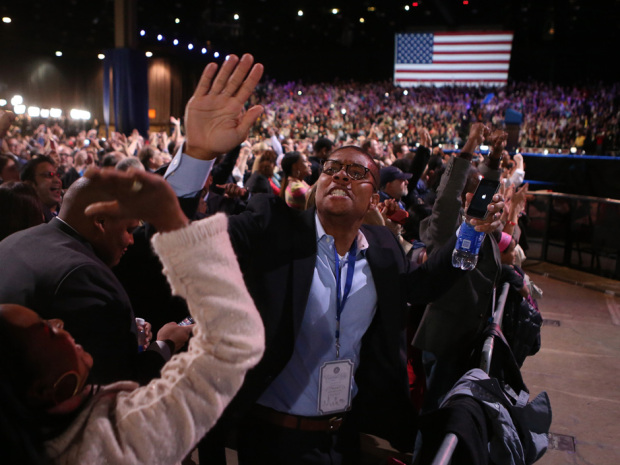
Chip Somodevilla/Getty Images: Supporters of U.S. President Barack Obama cheer after networks project Obama as reelected during the Obama Election Night watch party at McCormick Place November 6, 2012 in Chicago, Illinois
Democrats got off to a quick start in their bid to renew their Senate majority, capturing seats in Indiana and Massachusetts now in Republican hands.

In Maine, independent former Gov. Angus King was elected to succeed retiring GOP Sen. Olympia Snowe. He has not yet said which party he will side with, but Republicans attacked him in television advertising during the race, and Democrats rushed to his cause.

Polls were still open in much of the country as the two rivals began claiming the spoils of a brawl of an election in a year in which the struggling economy put a crimp in the middle class dreams of millions.

The president was in Chicago as he awaited the voters’ verdict on his four years in office. He told reporters he had a concession speech as well as victory remarks prepared. He congratulated Romney on a spirited campaign. “I know his supporters are just as engaged, just as enthusiastic and working just as hard today” as Obama’s own, he added.

Romney reciprocated, congratulating the man who he had campaigned against for more than a year.
Earlier, he raced to Ohio and Pennsylvania for Election Day campaigning and projected confidence as he flew home to Massachusetts. “We fought to the very end, and I think that’s why we’ll be successful,” he said, adding that he had finished writing a speech anticipating victory but nothing if the election went to his rival.

But the mood soured among the Republican high command as the votes came in and Obama ground out a lead in critical states.

Like Obama, Vice President Joe Biden was in Chicago as he waited to find out if he was in line for a second term. Republican running mate Paul Ryan was with Romney in Boston, although he kept one eye on his re-election campaign for a House seat in Wisconsin, just in case.

Supporters of US President Barack Obama cheer results on election night November 6, 2012 in Chicago, Illinois. AFP PHOTO / Saul LOEBSAUL LOEB/AFP/Getty Images
Voters also chose a new Congress to serve alongside the man who will be inaugurated president in January, Democrats defending their majority in the Senate, and Republicans in the House.

The long campaign’s cost soared into the billions, much of it spent on negative ads, some harshly so.

In the presidential race, an estimated one million commercials aired in nine battleground states where the rival camps agreed the election was most likely to be settled – Ohio, New Hampshire, Virginia, Florida, North Carolina, Wisconsin, Iowa, Colorado and Nevada.

In a months-long general election ad war that cost nearly $1 billion, Romney and Republican groups spent more than $550 million and Obama and his allies $381 million, according to organizations that track advertising.

In Virginia, the polls had been closed for several minutes when Obama’s campaign texted a call for volunteers “to make sure everyone who’s still in line gets to vote.”

In Florida, there were long lines at the hour set for polls to close. Under state law, everyone waiting was entitled to cast a ballot.

According to the exit poll, 53 percent of voters said Obama is more in touch with people like them, compared to 43 percent for Romney.

About 60% said taxes should be increased, taking sides on an issue that divided the president and Romney. Obama wants to let taxes rise on upper incomes, while Romney does not.

Other than the battlegrounds, big states were virtually ignored in the final months of the campaign. Romney wrote off New York, Illinois and California, while Obama made no attempt to carry Texas, much of the South or the Rocky Mountain region other than Colorado.

There were 33 Senate seats on the ballot, 23 of them defended by Democrats and the rest by Republicans.

REUTERS/Kevin Lamarque: Supporters of U.S. President Obama cheer during his election night rally in Chicago
 Democratic Rep. Chris Murphy, a Democrat, won a Connecticut seat long held by Sen. Joe Lieberman, retiring after a career that included a vice presidential spot on Al Gore’s ticket in 2000. It was Republican Linda McMahon’s second defeat in two tries, at a personal cost of $92 million.

The GOP needed a gain of three for a majority if Romney won, and four if Obama was re-elected. Neither Majority Leader Harry Reid of Nevada nor GOP leader Mitch McConnell of Kentucky was on the ballot, but each had high stakes in the outcome.

All 435 House seats were on the ballot, including five where one lawmaker ran against another as a result of once-a-decade redistricting to take population shifts into account. Democrats needed to pick up 25 seats to gain the majority they lost two years ago.

Depending on the outcome of a few races, it was possible that white men would wind up in a minority in the Democratic caucus for the first time.

Speaker John A. Boehner, R-Ohio, raised millions to finance get-out-the-vote operations in states without a robust presidential campaign, New York, Illinois and California among them. His goal was to minimize any losses, or possibly even gain ground, no matter Romney’s fate. House Democratic leader Rep. Nancy Pelosi of California campaigned aggressively, as well, and faced an uncertain political future if her party failed to win control.

In gubernatorial races, Republicans picked up North Carolina, where Pat McCrory won easily. The incumbent, Democratic Gov. Bev Purdue, did not seek re-election.

In a campaign that traversed contested Republican primaries last winter and spring, a pair of political conventions this summer and three presidential debates, Obama, Romney, Biden and Ryan spoke at hundreds of rallies, were serenaded by Bruce Springstein and Meat Loaf and washed down hamburgers, pizza, barbecue and burrito bowls.

Obama was elected the first black president in 2008, and four years later, Romney became the first Mormon to appear on a general election ballot. Yet one man’s race and the other’s religion were never major factors in this year’s campaign for the White House, a race dominated from the outset by the economy.

Over and over, Obama said that during his term the nation has begun to recover from the worst recession since the Great Depression. While he conceded progress has been slow, he accused Romney of offering recycled Republican policies that have helped the wealthy and harmed the middle class in the past and would do so again.

Romney countered that a second Obama term could mean a repeat recession in a country where economic growth has been weak and unemployment is worse now than when the president was inaugurated. A wealthy former businessman, he claimed the knowledge and the skills to put in place policies that would make the economy healthy again.

In a race where the two men disagreed often, one of the principal fault lines was over taxes. Obama campaigned for the renewal of income tax cuts set to expire on Dec. 31 at all income levels except above $200,000 for individuals and $250,000 for couples.

Romney said no one’s taxes should go up in uncertain economic times. In addition, he proposed a 20 percent cut across the board in income tax rates but said he would end or curtail a variety of tax breaks to make sure federal deficits didn’t rise.

The differences over taxes, the economy, Medicare, abortion and more were expressed in intensely negative advertising.

Obama launched first, shortly after Romney dispatched his Republican foes in his quest for the party nomination.

One memorable commercial showed Romney singing an off-key rendition of “America The Beautiful.” Pictures and signs scrolled by saying that his companies had shipped jobs to Mexico and China, that Massachusetts state jobs had gone to India while he was governor and that he has personal investments in Switzerland, Bermuda and the Cayman Islands.

Romney spent less on advertising than Obama. A collection of outside groups made up the difference, some of them operating under rules that allowed donors to remain anonymous. Most of the ads were of the attack variety. But the Republican National Committee relied on one that had a far softer touch, and seemed aimed at voters who had been drawn to the excitement caused by Obama’s first campaign. It referred to a growing national debt and unemployment, then said, “He tried. You tried. It’s OK to make a change.”

More than 30 million voters cast early ballots in nearly three dozen states, a reflection of the growing appeal of getting a jump on the traditional Election Day. NP