The Aneka Bantal Boneka

Showing posts with label Opinion. Show all posts

Thursday, October 4, 2012

Battling Hatred Begins at Home

Illustration
When President Susilo Bambang Yudhoyono proposed his idea to establish an international protocol against religious denigration at the UN General Assembly, he was probably not aware of all the domestic and international ramifications.

As the leader of a country with the largest Muslim population in the world, and one that has tried hard to project itself as a moderate force in international politics, he may indeed be in the best position to propose such a plan. However, the failure of the Indonesian government to protect the basic rights of various religious minorities at home raises questions about the credibility of his proposal

A closer inspection of Yudhoyono’s proposal makes us doubt whether it is possible to reach any international agreement on such a delicate and sensitive issue like religious denigration. Although it is easy to agree with the president that there is a need to establish an international platform on the promotion of interreligious harmony and peace, a strong resistance may still come from Western democracies if such a noble goal should be achieved at the expense of freedom of expression. As a matter of fact, in addressing the UN General Assembly, US President Barack Obama convinced his audience that he would never discourage American citizens from expressing themselves freely in any form.

Obama’s insistence to uphold the principle of freedom of expression in his country should not surprise us. As a liberal president he speaks on behalf of a secular society that tends to look at any religious belief system as not more than a human-constructed set of ideas that will never be immune from criticism and even mockery.

No wonder sharp and sometimes unjustified criticism of religions — especially Christianity — in Western, secular democracies is regarded as a normal contestation of ideas. If Yudhoyono’s proposal of an international protocol is meant to control or stop public discourses like this, it is doubtful that his plan will have any chance of success. We may expect that there will always be some irresponsible individuals out there who will be tempted to come up with a crazy idea — like the one that has led to the making of an anti-Islamic film “Innocence of Muslims.”

Therefore, before the government goes ahead with its plan to formulate a roadmap for an international protocol against religious denigration, let us re-think its plausibility and then come up with a more sensible idea.

Also, let’s not forget that no matter how compelling our moral exhortation in the international arena, at the end of the day effective promotion of interreligious harmony and peace is very much determined at the national level.

We live an era of globalization and liberalization of ideas. With Indonesia’s limited political and economic leverage, there is no way we can stop or control this trend. On top of that, all religious institutions now are under pressure to develop their apologetic system in order to argue against those trying to delegitimize their beliefs. Violent reactions will never solve this problem and sometimes make it even worse.

If the Indonesian government intends to substantiate its claim as a moderate force in international politics, it has to start with its own society. The more we can uphold interreligious tolerance in Indonesia, the more the international community will look at us as an example worthy of emulation. Promoting interreligious harmony after all is more about real-world action than about sophisticated diplomacy that is yet without substance.

Aleksius Jemadu is dean of the School of Social and Political Sciences at Universitas Pelita Harapan in Karawaci. JG

Wednesday, October 3, 2012

Keep Indonesia Free of Radical Clerics

Muslims attending prayers at a mosque in East Java. Indonesia should think of controversial measures to keep its mosques, boarding schools and institutions free of militant ideas. (AP Photo).
Some years ago, I attended Friday prayers at a mosque within the compound of Indonesia's Defense Ministry in Central Jakarta.

The prayer leader was a young preacher who delivered an off-the-cuff, hard-hitting sermon that criticized the government for not implementing sharia law in place of the man-made laws inherited from the Dutch.

A radical preacher at a government mosque? Nothing unusual here, as there were many others delivering similar sermons that amounted to "hate speech."

"Mosques have been taken over by preachers who deliver sermons and religious lectures that radicalize the congregation," said Ansyaad Mbai, head of the National Counterterrorism Agency (BNPT).

"They have replaced moderate clerics," he told me after prayers.

These preachers have been under the radar of counterterrorism officers for some time.

With the recent shooting spree against the police in Central Java and the Sept. 24 arrest of 10 militants — some still in their teens — said to have been planning suicide attacks against security forces and the government, the activities of these preachers are back in the spotlight.

Preachers with extremist ideas instigating intolerance openly through their lectures and sermons, and clandestinely to small groups of young Muslims, share part of the blame for the rising radicalism.

They complement the many unblocked extremist websites and local literature that fire up young Indonesians into radicalism.

Just whose responsibility is it to keep radicalism and such preachers at bay? Logically, it should be the Religious Affairs Ministry's. But it does not have specific deradicalization programs.

As radicalism grows, it is left to the security forces to deal with the problem until a government blueprint on deradicalization is implemented next year.

The issue of radicalism cropped up at a recent discussion when a BNPT official said Indonesia should study how other countries initiated measures to filter out radical preachers and curb radicalism.

One proposal is the certification of teachers and preachers to weed out those spreading hatred and provoking violence.

"With a certification program, the government could monitor the role of the ulama and prevent the fostering of radical movements," said Irfan Idris, director in charge of deradicalization at BNPT.

But the idea drew flak from Nahdlatul Ulama (NU), and even Indonesian Council of Ulema (MUI), the Islamic authority.

"The government is overstepping its authority by trying to dictate these things," said NU chairman Said Aqil Siroj. "Kiai (religious elders) or Ustadz (Islamic preachers) are titles that are not given out by the government."

Three years ago, the police floated the idea of vetting sermons because there were preachers who made hate speeches in mosques. But after many Muslim groups expressed outrage at the proposal, the plan was dropped.

Just like with the latest proposal on certification of preachers, Muslim groups were uncomfortable with the implications of monitoring the clerics' sermons.

First, they argued that the move would only bring back the bad old days of the Suharto's dictatorial regime when Muslim groups were repressed and religious scholars were monitored for "anti-Pancasila" activities. During that period, many preachers were jailed for advocating hatred, not so much against other religions, as against the government.

The police then were nothing more than an oppressive tool used to sustain the authoritarian regime. Preachers who could not face the repression fled into exile in Malaysia. They included radical clerics Abu Bakar Bashir and Abdullah Sungkar, who jointly founded the Jemaah Islamiah (JI) in Malaysia in 1992.

Second, there was an assumption that preachers were linked to terrorism — something that offended Muslims. This was despite radical cleric Abu Bakar Bashir topping the list of preachers allegedly involved in terrorism.

Bashir, who is serving a sentence for terrorism-related offenses, was the spiritual leader of JI. Blamed for a series of bombings in Indonesia since 2002, he founded the Jamaah Anshorut Tauhid, the organization that has become notorious because many of the detained militants are linked to it.

NU rejected any links between the ulama and terrorism, saying "terrorism is not rooted in Islamic culture".

But those who opposed the proposal have missed the point that Indonesia needs a mechanism to curb extremist preachers from corrupting the youth, or at least limit their influence. There are merits in reviewing how other countries cope with the problem.

Saudi Arabia has had religion-based programs against radicalization for years. Turkey and Malaysia have long kept a tight grip on what clerics can and cannot preach.

Indonesia, obviously torn between its commitment to democratic freedom and its revulsion against terrorism, should not feel inhibited to think of controversial measures to keep its mosques, boarding schools and other institutions free of militant ideas.

Reprinted courtesy of The Straits Times

Monday, September 24, 2012

Ancient Site Needs Saving Not Destroying

A Buddhist statue overlooks a Chinese government-owned mining compound in Logar province, Afghanistan. Mes Aynak, a 2,600-year-old Buddhist site, could be destroyed in December to create a massive copper mine.
Please bear with me as I ask you to briefly use your imagination. Close your eyes. Imagine Machu Picchu at dawn cloaked in fog. Now imagine the fog slowly lifting to reveal an enormous ancient city perched on the edge of a mountain.

Picture a sense of mystery being immersed in thousands of years of history as you walk between antiquated hewn stone structures. There is tranquility in the wind-blown stillness of the primeval site. You feel a renewed sense of kinship with the past and with your ancestors and feel a deep reverence for their lives and accomplishments.

Now imagine the menacing sound of bulldozers closing in and men at work. Their heavy machinery rattles the ground. You hear workers rigging dynamite to these massive stone structures. There is a brief lull and then the deafening blow of multiple explosions as Machu Picchu is razed to the ground.

Be at ease, Machu Piccu is a UNESCO protected site. But a very similar 2,600-year-old Buddhist site in Logar province, Afghanistan isn't so lucky.

This site is called Mes Aynak and is nothing short of awe-inspiring: a massive walled-in Buddhist city featuring massive temples, monasteries, and thousands of Buddhist statues that managed to survive looters and the Taliban. Holding a key position on the Silk Road, Mes Aynak was also an international hub for traders and pilgrims from all over Asia.

Locals from relocated villages near Mes Aynak remove dirt and rocks to expose buried artifacts.
Hundreds of fragile manuscripts detailing daily life at the site are still yet to be excavated. Beneath the Buddhist dwellings is an even older yet-unearthed Bronze age site indicated by several recent archaeological findings.

Mes Aynak is set for destruction at the end of December 2012. All of the temples, monasteries, statues as well as the Bronze age material will all be destroyed by a Chinese government-owned company called China Metallurgical Group Corporation (MCC). Six villages and the mountain range will also be destroyed to create a massive open-pit style copper mine.

In 2007, MCC outbid competitors with a $3 billion bid to lease the area for 30 years. MCC plans to extract over $100 billion worth of copper located directly beneath the Buddhist site. Ironically, the Buddhists were also mining for copper albeit in a more primitive fashion.

MCC says they weren't told about the archaeology site's existence until after the contract was signed. Following significant international pressure and perhaps sensing an impending PR nightmare, MCC in 2009 gave archaeologists three years to attempt to excavate the site.

Archaeologists say they need at least 30 years to do the job but had no choice but to accept MCCs brief timetable. Specialists on site are working with extremely limited funding and the crudest of tools.

Afghan archaeologists, who do the majority of the excavation, don't have access to computers or digital cameras and have been sleeping on the floor in a wooden shack when staying on the site overnight.

Today, three teams of international archaeologists led by DAFA, a French archaeological delegation, scramble to save as many relics as they can. These experts are performing rushed rescue archeology, which focuses on removing movable objects and not on preserving structures.

A gold-plated Buddha head found at Mes Aynak. A team of international archaeologists is scrambling to save relics.
Archaeologists now have less than four months to do three decades worth of excavation. They are also risking their lives daily as locals of Logar Province, angry at the loss of their villages partner with the Taliban to regularly attack both the MCC site and the archaeology location with rockets and land mines.

In July, a Logar worker unearthed a landmine that exploded in his face. Later that month, four Afghan policemen were killed by a landmine on the road leading to the archaeology site.

I am often asked, "Why save it? It is, after all, just another remnant of the past, right?" Wrong.

Mes Aynak is the missing link that shows Afghanistan's interconnectivity throughout Asia on the Silk Road. Afghanistan needs to see the value of learning its own cultural history as too often the country's story is co-opted by the lens of another.

Afghans need to claim their cultural significance in the world for current and new generations. And the findings at Mes Aynak will be the key to doing that.

In addition to Mes Aynak's historical significance, the site is breathtaking to behold in person. I can't help but feel privileged and honored to have been able to set foot inside its ancient walls, to have been able to bare witness to massive Buddhas, many of which are still coated in gold paint overlooking their ancient city.

These statues have miraculously survived looting, survived the intense heat and cold, and survived over three decades of continuous war.

There is a magic to Mes Aynak -- an ability to draw in people from around the world who will risk their lives to save it. I fell in love with this ancient site and will do everything in my power to try to help save it.

People work at one of the many archaeological excavation sites at Mes Aynak. In 2009, the mining company gave archaeologists three years to excavate the site.
It sickens me to know that in a short time this site will be destroyed in the same violent and disrespectful way the Buddha of Bamyan was destroyed. This desecration shows no reverence to culture or religion.

Imagine someone bulldozing your grandparents' graves and blowing up their cemetery. How could the world look away letting such crime happen in the name of capitalism?

Unfortunately, Mes Aynak has gained some powerful enemies. MCC, The World Bank and Afghan ministries all want mining to start ASAP.

In my opinion, they want Mes Aynak to set a precedent -- to be a model for resource extraction of the one trillion dollars plus of valuable minerals like oil, copper, lithium and iron buried underneath Afghanistan.

According to archaeologists that I spoke with, every mining location holds cultural heritage. On every potential mine lies an ancient site like Mes Aynak. So, even worse than the senseless destruction of Mes Aynak, is the thought that this kind of cheap destructive process will be replicated all across Afghanistan.

I often hear talk about mineral extraction being somehow good for Afghanistan, but I promise you this is not the case.

Given the country's out of control corruption there are a privileged few who will see any payout from such endeavors. Afghan citizens have absolutely nothing to gain from this copper mine or any other international extractive industry.

I believe Chinese will bring in their own laborers to manage the mine and Afghans will be given only low level and terribly paid positions working in slave-like conditions.

And I have said nothing about the environmental devastation. Many mining experts have told me the toxic pollution from the mine will likely turn Mes Aynak into a site so toxic that in the future people will be advised against even setting foot on the ground. They tell me this pollution will be permanent, rivers will be polluted and the toxins will travel to other areas -- and the locals have never been educated about these risks to the area.

So not only will Afghanistan lose an ancient site, a key to unlocking its important history, but the country will lose the land and everything living on it. And what happens when Afghanistan needs copper or oil or iron for its own development? Will they have to buy it back from China at inflated rates?

My fear is that in the future Afghanistan will consist of hundreds of these gaping toxic craters and the resources the country needs for its own development will be lost. Afghans will see no benefit. They will suffer from irreversible environmental devastation and the permanent loss of invaluable cultural heritage.

So as a final request I want you to close your eyes once again. Imagine a city-sized toxic crater in the ground where the majestic Machu Picchu once stood. That sight, unfortunately, is the future of Mes Aynak unless we do something to stop it. By Brent Huffman

Tuesday, September 18, 2012

Indonesia Is (Not) a Tempe Nation

Some producers of tofu and tempe who are members of Tempe and Tofu Producer Cooperation throws away tofu after raiding tempe and tofu stalls in markets in Semanan that did not join the strike scheduled from Wednesday to Friday. (Antara Photo)
Indonesian founding president Sukarno, in his fiery speech in 1963, said, "We reach the sky, control the land and seas. We are a hard-working nation, not a 'tempe' nation, nor a nation of coolies. We fight at any cost and willing to suffer to achieve our nation's goals.”

The president was not referring tempe as an inferior food product, but in the course of Indonesia's history, tempe has often been associated with weakness, sufferings and  oppression.

Dutch Governor General van den Bosch ordered forced labor in 1830 and all Indonesians who worked for plantations had to consume mandatory cheap food derived from cassava and soybeans, of which tempe is made. Tempe was founded during those years.

At a time when the Dutch colonial rulers feast on fried chicken, stewed meat and gurame fish, inlanders or locals, had only tempe, tahu (tofu) and kerupuk (crackers) to eat with steamed rice, according to one account of history.

For ages, tempe has became a popular for its rich nutritions. Until today, no household is without tempe. Sukarno, Suharto, Gus Dur, Megawati and Susilo Bambang Yudhoyono, and the majority of people alike always craved for tempe at all times.

Tempe is always good whether its plain-fried, sambal tempe, tempe bacem, or tempe cracker which is exceptionally good with an ice-cold Heineken. And the best quality tempe comes from the area of Wonogiri which borders Central and East Java, where home-grown soybean is of the best quality.

But alas, tempe is no longer abundant or affordable. 80 percent of the soybeans had to be imported. Price of a kilogram of soybeans is now twice as high. In some places, they are no longer available. Tempe has become a rare luxury. The common Indonesians are now without tempe — their only alternative source of protein to more expensive chicken or beef.

Tempe makers have refused to make tempe due to unaffordable prices. Meanwhile soybean farmers resent high prices of imports. They can no longer earn a living cultivating soybeans. Protests and clashes were seen in several traditional markets in Jakarta and other major cities across the country.

The tempe crisis is a reflection of failure on the part of the current administration to protect the farmers and the nation’s need for food security. Carried away and buoyed by the comfort of easy free-market and import policies, the government is now trapped for being too dependent on other countries which are now experiencing slowdown in farming due to drought. It is now at a worrying stage.

Agriculture Minister Suswono doesn’t have a way out but he has to be responsible. He has failed.

Coordinating Minister for the Economy Hatta Rajasa can’t do anything either, or even President Susilo Bambang Yudhoyono. The most they can do is to free import duties to lower prices. That won’t solve the problem. The only way out is to protect our own agriculture sector and food industry.

After more than 60 years of independence, and recalling Sukarno’s wish that Indonesia should not be a tempe nation, it’s an irony now that even becoming a tempe nation has been proved to be very difficult.

by Yanto Soegiarto

Friday, September 14, 2012

Certification of Ulema Would Help Protect Fabric of Our Plural Nation

'Would you go see a doctor who had not completed a course in medicine in a respected university if you were feeling unwell?'
Following comments from the National Counterterrorism Agency that there are Internet sites that propagate radicalism and terror here, the spokesman of the Ministry of Communication and Information, Gatot Dewa Broto, indicated that his office might block radicalizing sites.

Asking the agency known as BNPT for the list of such worrying sites he promised that the government would scrutinize them to determine whether or not they have radical content. The spokesman’s statement indicates that the experts in that ministry cannot and have not, in all these years, been able to find for themselves these radical sites.

Some of us might still remember Arifinto of the Prosperous Justice Party (PKS), which is also Communication and Information Minister Tifatul Sembiring’s party.

Arifinto was caught watching porn during a plenary session of the House of Representatives to discuss important affairs of the state. Obviously he had no problem in seeking out porn sites on the Internet. This was of course done with the sole intent of scrutinizing Internet porn from beginning to end to determine whether or not it is harmful to our nation’s morals. God forbid that anyone should ever even imagine that the honorable members of this religious party would ever touch Internet porn sites with a long pole, other than for the noble purpose of protecting us from moral degradation.

We are grateful that the ministry has blocked many porn sites, so that porn is now much less accessible.

But why has it taken so long for the ministry to find and block radical sites in the religious sphere?

There are Indonesian websites that routinely criticize democracy, the government, the police, the West, Christians, Ahmadis, Shiites and other minorities. While always declaring the martyr status of dead terrorists and glorifying organizations such as Al-Qaeda, they diligently vilify the police, especially targeting the anti-terror unit.

In the wake of the recent terror attacks and accidents in Indonesia, comments of Rizieq Shihab from the Islamic Defenders Front (FPI) were published, stating that the BNPT’s suggestion to certify clerics — like Singapore and Saudi Arabia do — was a blasphemous idea, and that Muslims should prepare to resist BNPT and the anti-terror police.

Worryingly, people who usually stand out as beacons of reason, such as Mahfud M.D. of the Constitutional Court and Said Aqil Siradj of Nahdlatul Ulama, also stated their opposition to the idea of certifying religious scholars, or ulema.

Said Aqil said that this would be the state interfering too much in the private lives of their citizens and Mahfud said that such certification would violate the human rights of Muslims. Each and every Muslim is compelled to spread the word “if only one verse” so there cannot be any limitation on who can proselytize.

Unfortunately these two gentlemen, whom I respect very much, have got it totally wrong.

Would they go see a doctor who had not completed a course in medicine in a respected university if they were feeling unwell? Would they hire a driver who had no driving license?

Would they prefer to fly in a plane that had just been safety-checked by a local bicycle mechanic and was being flown by a Jakarta bajaj driver or would they rather their plane be checked by competent mechanics and flown by experienced pilots?

The same goes for ulema.

The general public would prefer to listen to ulema that are genuine men and women of God, rather than listen to confidence acts who dress up in robes and grow their beards in lieu of really studying and practicing the whole body of religious texts that a real cleric is expected to have done.

The problem I feel is not in the need of certifying ulema to make sure that the general public receives quality spiritual guidance, but rather the issue would be: who would be competent to issue such certificates that guarantee the ulema we see are truly people of wisdom and knowledge?

Should the Religious Affairs Ministry conduct the certification of ulema?

Notorious as one of the most corrupt institutions in the country, where even the procurement of the Holy Korans to be distributed throughout the state apparently has been marked-up, the concern would be that ulema certificates could merely be sold to the highest bidder.

The Indonesian Council of Ulema (MUI) is also not an institution entirely clean of controversy, and there are worrying indications that there are anti-Indonesia elements within it. Some are preaching that saluting the red and white national flag is haram, and MUI has also issued fatwas that are used by some as licenses to attack minorities.

The controversial 2005 fatwa declaring that secularism, pluralism and liberalism is haram and evil is an indirect attack against the state philosophy of Pancasila. If the MUI was given the task of certifying ulema, it may just be possible that all the moderate ulema would be stricken off and instead certificates would be issued to people propagating the destruction of the Republic and the establishment of a caliphate.

Maybe for the time being we cannot expect any certification of ulema to be practicable. But perhaps the more realistic demand would be for ulema to be honest about their education.

The ulema are scholars, people of knowledge. The Arabic word actually has the same root as “ilmu,” which means science.

As one expects to know the qualifications of a teacher in a school, the public should also know the qualifications of someone who preaches from the pulpit, especially when there also are those who preach hatred and violence in the name of religion. While we work out how to go about this, it would of course be most helpful if the Communication and Information Ministry started blocking radicalizing websites that are intent on destroying the fabric of our plural nation.

Bramantyo Prijosusilo is a writer, organic farmer and former broadcast journalist

Thursday, September 13, 2012

Can Muslims Take Non-Muslims as Leaders?

Rhoma Irama arriving at the office of Jakarta Election Supervisory Committee (Panwaslu). He was summoned to explain his mosque sermon against voting for Jakarta gubernatorial candidate pairing Joko Widodo and Basuki Tjahaja Purnama. (Antara Photo)
On the first day of Ramadan, two friends — one a member of Indonesian Democratic Party of Struggle (PDI-P), another a member of Jakarta gubernatorial candidate Joko Widodo’s campaign team — and I were discussing the results of the July Jakarta election in a public library in Menteng, Central Jakarta.

Although named the official winners of the first round of the Jakarta gubernatorial race, the Solo mayor and his running mate, Basuki "Ahok" Purnama, still face an uphill battle.


Worried about “dirty” strategies that could be used by their opponent in the runoff election, my friend who's a member of the Jokowi campaign team asked me if there was a verse in the Holy Koran that allows Muslims to choose non-Muslims as their leader. Not knowing the answer, I shrugged.


He said he wanted to look for the verse to back his candidate, Ahok, who is of Chinese ethnicity and a Christian. He believes Islam tolerates Muslims befriending non-believers. 


The aim is to later “infiltrate” Muslim clerics in Jakarta by spreading these messages during Idul Fitri, when large numbers of Muslims gathered in place of worships listening to post-Ramadan sermons. Both my PDI-P friend and I objected to the idea, arguing politics shouldn’t sink that low.


The conversation took place before the king of dangdut, Rhoma Irama, controversially called on Muslims to vote for Muslims during a sermon. It was before Jakarta Governor Fauzi Bowo sat among devotees at Al-Muttaqin mosque, where a preacher delivering his sermon proclaimed, "Muslims must pick a leader of the same faith."


The idea of using such low tactics to reach the desired goals perched on both sides. The difference is one retreated, the other went on with it.


Sullying Idul Fitri


Idul Fitri is a holy time when Muslims celebrate the past month of fasting from worldly desires. Allowing dirty campaigns into a public sphere like a mosque is out of the question. 

Sadly, during Idul Fitri prayer at a local mosque in Sunter, North Jakarta, last month, the preacher quoted a verse from the Koran that said Muslims should not choose non-Muslims to be their leaders.

As I was sitting in the mosque and listening to the khutba (or sermon), I reached into my trouser's pocket and pulled out my iPhone. According to my iQuran app, the verse cited by the preacher (QS 5:51) says:

"O you who believe! Do not take the Jews and the Christians for friends; they are friends of each other; and whoever amongst you takes them for a friend, then surely he is one of them; surely Allah does not guide the unjust people."

From the iQuran version, clearly the verse makes no reference to a leader. So, I approached the preacher after the prayer session adjourned and asked for a clarification.

He told me the original word used, “awliya,” translates to leader or master. But, from the solid proof I had in my hand, I insisted that it said “friend,” not “leader.”

Our conversation didn't go anywhere, so I rushed home and consulted Al-Lubab, a tafsir (interpretation) book, written by former religious affairs minister and renowned cleric Quraish Shihab.

In the book, Quraish doesn't translate “awliya” to leader, but to faithful friend ("kawan yang dapat dipercaya") instead.

In his interpretation, Quraish elaborated it to what I think is the most important point in this debacle: That Islam allows Muslims to deal kindly and justly with non-Muslims as long as they are kind and courteous.

Supporting this argument, another verse (QS 60:9) in the Koran says:

"Allah only forbids you with regard to those who fight you for your faith, and drive you out of your homes and support others in driving you out, from turning to them for protection (or taking them as wali). Those who seek their protection they are indeed wrongdoers."

Quick Internet searches lead to this: In Sunni Islam, “awliya” is generally short for “waliulah” or friend of God. Shiite Muslims, on the other hand, believe the term means the one vested with the “authority of God.” And this is the fundamental part where Sunni and Shiites diverge.

Shiites reject Sunni's interpretation that Muslims may not take non-Muslims as a friend, whereas they interpret the verse as to not allow Jews and Christians to act as “authorities” over Muslims.

Not to mention Prophet Muhammad's kindness and mercy to non-Muslims. Muhammad, in his lifetime, was kind to the pagans in Mecca and fought them only when they fought him.

The Koran Should Be Read in Context

Just last week, I encountered another similar topic during the Friday prayer sermon at a mosque next to my office building in Gatot Subroto, South Jakarta. This time, the preacher cited another verse that carried the same message:

"O you who believe! Do not take for intimate friends from among others than your own people; they do not fall short of inflicting loss upon you; they love what distresses you; vehement hatred has already appeared from out of their mouths, and what their breasts conceal is greater still; indeed, we have made the communications clear to you, if you will understand" (QS 3: 118).

Unwilling to deal with the same propaganda twice, I approached the preacher and asked for clarifications. Again.

He said “awliya” has varied meanings. "It could be ‘intimate friends’ or 'master,'" he said.

Armed with my research, I proceeded to ask him another question: "But sura' Al Mumtahinah verse 9 says that Allah only forbids us from taking non-Muslims as a friend — or a leader, for that matter — in exceptional circumstances, such as when they attack us or wrong us."

To which he replied: "No, it doesn't say so. Do not make allies with those who are not from your group affiliation."

"Even if they do no harm toward us?"

"Yes. Muslims should only choose among ourselves."

"What about Muslims in countries where they're the minority group, and no Muslim political leaders are running for position?"

"It's better to not use their political right than to have to vote for non-Muslims."

'Leaders,' 'friends,' whatever the correct translation is, it's unwise to take these verses at face value. The noble Koran is God's divine words and there is a reason behind the revelation of the Koran and every verse in it. And one must look at them contextually.

by Abdul Qowi Bastian

Tuesday, September 11, 2012

Indonesia's Religious Diversity Under Threat

This photo taken in Sampang, East Java on August 26, 2012 shows two men attacking a house in Sampang. Two people were killed and dozens of homes torched in an attack on Shiites in Indonesia, a human rights group said on August 27, in the latest sign of rising intolerance in the world's largest Muslim country. (AFP Photo)
Two contrasting pictures of Indonesian life emerged in the recent Idul Fitri celebrations.

The first: A Catholic church ground in Malang, East Java, serving as a venue for mass Idul Fitri prayers for Muslims last month.

The second: A 500-strong Sunni mob attacking a group of 30 Shiites with machetes and sickles in Sampang, East Java. Two Shi'ites were killed and 40 houses torched in this sectarian violence on August 26.

The first picture portrays Catholics reaching out to their Muslim neighbors in solidarity with their religious observances, reflecting the spirit of religious harmony.

Sampang, East Java on August 26, 2012 (Manado News Photo)
But it is the second picture that has caught world attention. It is yet another example of the violence that has shaken Indonesia's reputation for religious tolerance. And it comes as the world reads reports of attacks against minorities and churches in recent years.

"We regret this incident," said President Susilo Bambang Yudhoyono. "And, to be honest, it stains our religious tolerance and peace in our society."

One factor that may explain declining religious tolerance is the rise in religiosity among hardliners, who believe Islam is a superior religion and other faiths should acknowledge this position.

They do not accept the reality that diversity in beliefs and practices is a fact of life even within Islam. They treat other faiths and beliefs as if they are an aberration that should not be allowed to grow.

Secondly, there is a sense of insecurity among clerics and their hardline followers who see diversity as a threat.

So, the presence of a Shi'ite minority in a hamlet in Sampang is viewed as a threat to the growth of the Sunni majority. The clerics probably fear their followers may turn Shiite, so they initiate moves to curb Shiism, the second branch of Islamic orthodoxy.

Similarly, a church or church construction project in a predominantly Muslim area would arouse their suspicion that Christians will proselytize to Muslims, prompting some to instigate attacks on churches and to block Christians from attending church services.

Ignorance also comes into play. The Sunni mob on the rampage in Sampang was ignorant of Shiism as part of Islamic orthodoxy, and chose to believe their clerics that Shi'ites are heretics. Nor are such views confined to the flock; even Religious Minister Suryadharma Ali declared Shiism a deviant sect.

Muslim hardliners' ignorance of Christianity also fuels their opposition to churches. Many cannot tell the difference between the various Christian denominations and do not understand why a group of Christians would want to build a church when one already exists nearby.

These factors need not necessarily lead to violence but, sadly, many incidents have flared up.

The culprits are emboldened when they get off scot-free after an attack, with the police seemingly afraid of taking action for fear of a backlash. Some analysts warn that if a violent culture becomes embedded among hardline groups, more violence will result when followers see it as the only option to counter threatening groups and their beliefs.

This is why it is paramount for the state and religious leaders to act together to stamp out religious violence and to promote tolerance.

The state has to tighten law enforcement to drive home the message that sectarian violence will be punished. The police must detain those who take part in or instigate attacks. The courts must impose stiff penalties. Too many perpetrators of violence against minorities have been set free while the victims were jailed.

Clear enforcement will send the message that the state will protect religious minorities, so that intolerant groups will not see them as fair game for violent attacks. The authorities must rein in the numerous hardline groups whose agenda is to incite violence against minorities.

The religious elites can play a role by helping the government to encourage reconciliation and mutual understanding between religious groups.

Religious leaders must denounce any act of violence carried out in the name of any religious school of thought. Those in authority could even introduce a fatwa that makes it a sin to harm people of different beliefs.

There must be concerted attempts at instilling a culture of tolerance through education and dialogues, so society can accept diversity as a fact and not a threat. Only then can Indonesia return to the ideal expressed in its motto, 'bhinneka tunggal ika,' or unity in diversity.

Salim Osman, reprinted courtesy of The Straits Times

Tuesday, September 4, 2012

Indonesia : We Do Not Need Electric Cars Except For Public Transport

Minister of State Owned Enterprises, Dahlan Iskan, has a test drive the Indonesian made elcetric car (trulyindonesia)
We have been witnessing euphoria about electric car production in our public discourse, with the government aiming to mass produce 10,000 such vehicles in 2014. The talk about electric cars emerges hot on the heels of a government policy to curb fuel subsidies.

As part of that policy, the government once planned to promote the use of gas for the transportation sector. Electric cars, however, are a more likely answer to address mounting pressures on fuel subsidies resulting from increased fossil fuel consumption.

Moreover, with growing public awareness of global warming and the increasingly urgent need to reduce carbon emissions, the role of electric cars in our transportation system looks unavoidable. The next questions are: “How ready are we?” and “How should we deal with this electric car discourse?”

Electric cars are not new.  Technology for electric-powered cars was first developed in the 19th century, although it is unclear who exactly started developing the technology. Some sources say that in 1828, a Hungarian, Anyos Jedlik, developed an early type of electric engine, which was used to power a car. In the United States, Thomas Davenport developed an electric engine, which installed in a mini car model in 1834.

However, the development of electric-powered cars did not last long due to the development of technology using internal combustion offering more powerful thrust, the capacity to power a vehicle longer distances and energy that was relatively cheaper than electric cars in terms of battery installation. The battery in an electric car is still more expensive and less economical than that in a conventional car.

Indeed, there are a number of social benefits of electric cars when compared to petroleum-fueled cars.

First, the use of electrical energy derived from domestic power generation will increase economic growth. Second, the reduction of air pollution in cities will improve public health quality. Third, there is a reduction in noise levels. Fourth, the intensive use of electricity infrastructure will optimize the value to be gained from the electricity infrastructure; and, fifth, the potential for reducing renewable electricity integration costs.

However, a number of potential social costs arising from the use of electric-powered cars can also be identified when the cost per unit in electric car usage is becoming cheaper. First, the increasing traffic congestion; the use of electric cars will certainly increase traffic density, particularly in places where a car culture is prevalent.

Second, the pollution problem, which will occur when there is “competition” in power resource utilization between cars and other electric devices needed by households and industries. Electricity, which can be used to reduce air pollution in industrial activities, will instead go to electric cars.

Third, unlike conventional cars, electric cars are relatively less noisy so there will likely be an increase in traffic accidents involving pedestrians. Fourth, the rising potential cost of electricity infrastructure if smart-charging technology is not well developed (Conrad, 2011).

If we look at the population of motor vehicles and traffic conditions in Indonesia, such as in Jakarta, the country has been engulfed by a car culture. Based on 2010 data from the Central Statistics Agency (BPS), there were about 76.9 million motor vehicles on the roads at that time. Private cars accounted for around 8.8 million and motorcycles dominated the population with around 61 million on the roads. As for public buses, the total only reached 2.25 million.

This data clearly demonstrates that a strong car culture prevails in Indonesia. Studies conducted by the Japan International Corporation Agency (JICA) and the Institute for Transportation and Development Policy (ITDP) show that the increase in the number of vehicles in Jakarta averages about 11 percent per year, while new road infrastructure accounts for less than 1 percent. In addition, fuel subsidies still exist, making public transport less competitive when compared to private cars. Moreover, electric car technology is still very expensive compared to internal combustion engine cars.

Under these conditions, it appears that the discourse about electric cars is not timely. Furthermore, Conrad (2011) indicated that if electric cars were to be mass-marketed, the technology would have to accommodate both casual users of electric cars, ie: those who only drive their cars occasionally, and frequent users of electric cars.

As long as the technology remains expensive and battery capabilities are unable to store lasting power in an efficient manner, and for as long as subsidized fuel remains available, electric cars will be less economical compared to conventional cars. Not to mention the electricity infrastructure, which is not yet ready.

If electric cars obtain electricity from power plants that rely on fossil fuels, then the argument that electric cars will be environmentally friendly cannot be justified. If that happens, it only shifts fossil fuel consumption from power plants to electric cars.

If the government really wants to develop electrical energy for our transportation system, there should be a consistent logical sequence ranging from upstream strategies and technology in generating electrical energy that should already be environmentally friendly and sustainable, to the downstream in the form of convenient and reliable electric mass transportation.

There is no use in promoting electric cars for personal use when our roads are already congested.

Teddy Lesmana, The writer is a researcher at the Center for Economic Research, Indonesian Institute of Sciences (LIPI), Jakarta

Thursday, August 30, 2012

Why Indonesians Don't Read More Books ?


As I was sitting inside a crowded TransJakarta bus, I reached into my bag and opened a half-read novel. I couldn’t help but feel people staring at me strangely for doing this relatively humdrum thing. I was tempted to tell them, "I’m just reading, everyone, nothing to see here."

Come to think of it, though, reading books is probably not the most common activity that one can be seen doing in public setting in Indonesia. Office employees might still be found perusing newspapers on their way to work or ladies at a beauty salon will be giving instruction to their hairdressers while holding women’s magazines. But why not books?

One of the reasons I mostly heard is the lack of time. Yes, our lives have become more fast-paced and busy now, but this fact shouldn’t avoid you from going to a bookstore and picking an enticing book to read. Busy at work the whole day? You can still read at night one chapter at a time, and before you know it, you will finish a thick memoir.

Meanwhile, some other people seem to prefer other form of media to consume, from the aforementioned newspapers and magazines to television and Internet. They can provide you with faster and more practical information, but there are several features that are not provided by the consumption of such media, especially when you compare them with fictional books. According to this Harvard Business Review article, reading novels can give you various benefits, such as making one better in understanding human emotion.

There is also one of the modern symptoms that I find pervasive: most of us are tethered to our mobile gadgets nowadays and get addicted to social networking sites. This has arguably shortened our attention span, and I have to admit that sometimes I feel that mine is getting shorter by the minute, too. With less than 140 characters per tweet, scrolling through your Twitter timeline sounds more tempting than having to leaf through hundreds of pages.

Probably this is also why some Indonesians are enamored by the concept of "kultwit" (literally means "Twitter lecture"), where a user will explain about a certain object — be it a social phenomenon, current affairs, or even scientific object — through a series of tweets. But at its best, the information you get from Twitter can only enrich your mind so far because everything is being discussed on a superficial level. Meanwhile with books, you can understand a subject matter in a more detailed and thorough manner.

Going all the way to the roots I believe the educational system we have in our country can take the blame to a certain extent on why most Indonesians are not keen of reading books. I was educated in public schools from elementary to high school, and as far as I can remember, I was rarely assigned to read books — in this case, literature — for my English and Bahasa Indonesia courses. Even though my fellow friends and I sometimes encountered passages from famous Indonesian authors’ literary works in our textbook, our teacher never pushed us to dig deeper and read. As a result, most students’ understanding about literature was insufficient and they ended up not appreciating books.

Thankfully, I was raised in a book-loving home — I was one of those kids who prefer to get a gift of books than toys — which turns me into a bibliophile-slash-book-hoarder today. Even if your school never gave you an assignment to read "Catcher in the Rye,” you can read it for yourself and find out who this Holden Caulfield character truly is. Because in its very essence, reading is about self-actualization and making yourself more knowledgeable.

If you are now intrigued to read more, what to do? Go to a bookstore is the most obvious thing to do. And yet I still lament the selection in some Indonesian bookstores. If you pay a visit to stores like Gramedia, the best-seller section is stacked with Indonesian books whose topics make me furious most of the time: self-help motivations, tips on how to get rich fast, or, more horrendously, conspiracy theories that are peppered with the words “Zionist” or “horror secrets.” No worries, though, because Indonesia still has a troupe of excellent writers, such as Dewi "Dee" Lestari and Ayu Utami, whose novels are critically acclaimed.

And if you think that book prices are getting more expensive nowadays, there are always the libraries. Granted, you cannot easily find it in every corner of Jakarta, but there are a number of well-stocked and comfortable libraries you can visit here, including the Freedom Library in Menteng.

Also, there have been some admirable initiatives to foster the love of books. One of them is Drive Books Not Cars, which organizes donation of children’s books for Taman Bacaan Pelangi. They also hold a second-hand book fair several times in a year whose proceed will be donated to the Sahabat Anak foundation.

At the end of the day, I still harbor a hope that more Indonesians will discover the pleasure of books and, along the way, support our own excellent writers.

And if you still have a doubt on why you should read, let me leave you with this quote by the late writer extraordinaire Nora Ephron from her book "I Feel Bad About My Neck":

"Reading is everything. Reading makes me feel like I've accomplished something, learned something, become a better person. Reading makes me smarter. Reading gives me something to talk about later on. Reading is the unbelievably healthy way my attention deficit disorder medicates itself. Reading is escape, and the opposite of escape; it's a way to make contact with reality after a day of making things up, and it's a way of making contact with someone else's imagination after a day that's all too real. Reading is grist. Reading is bliss."

by Nico Novito

Tuesday, August 14, 2012

Indonesia : The Miracle of Mudik

Illustration Picture
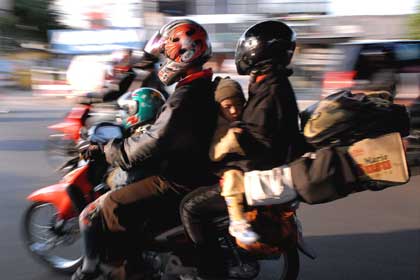
The virtues of mudik, the long-established tradition of returning to hometowns, which millions of Indonesians do to celebrate Idul Fitri with their parents and relatives, are that it rekindles familial ties, fosters solidarity among fellow travelers and regenerates the economies of sleepy towns and villages.

It is predicted that more than 12 million people, most of them workers in big cities across the country, will travel by land, air or sea to their hometowns this year to celebrate Idul Fitri, the holiday that marks the end of the fasting month of Ramadan, which is expected to fall on Aug. 19-20.

An upsurge in the number of travelers means that highways, especially in Java, will be crammed with motorcycles, cars and public buses. That will require the police and transportation officials to undertake extra work to ensure a smooth flow of traffic, security and safety for holiday revelers.

People who can afford it can choose to travel by air or at least book a seat in an executive-class train, reaching in their destinations in a bit more comfort. But those who barely make ends meet have to ride motorcycles — often sharing their seat with their wife and children — covering hundreds of kilometers to get to their villages.

Despite repeated government warnings, thousands of motorcyclists still risk life and limb by piling onto their bikes because they cannot afford bus or train tickets. But, they say, it’s all worth it because they can feel the sheer joy of Idul Fitri when they are among their loved ones.

This shows how important mudik is to the Indonesian people. Like Thanksgiving in the United States, mudik has become an inherent part of people’s lives. Regardless of whether they are white-collar workers or blue-collar ones, they will do everything they can to take part in the exodus.

Morally, mudik is a concrete undertaking to show filial affection to one’s elders and relatives, as well as friendship with former neighbors.

Economically, it is a practical way of distributing wealth from big cities to less-developed towns and rural areas, as the people arriving in their home villages usually bring souvenirs for family and friends, along with money for the rural people.

Mudik is also a good time for migrants to contemplate what they have achieved in the big city after leaving their towns or villages, which are less boisterous and polluted than the surroundings in which they now live. It is also a time when they can share their urban experiences with fellow townspeople and villagers.

Anticipating that this year’s mudik will be much livelier than usual, given that the nation is preparing to celebrate the 67th anniversary of the country’s independence on Aug. 17, just a couple of days before Idul Fitri, the government has made concerted efforts to make travelers comfortable and safe during their journeys.

Dozens of new train cars have been built and more ferries will be operated to accommodate the increasing number of passengers. And the annual repair work on the main roads used in the mudik has been completed on time, which will help minimize delays. In addition, more people are buying travel tickets online, avoiding further hassle.

Thousands of police officers have been deployed at main airports and harbors to keep down the criminal element, and officials from the Transportation Ministry have conducted inspections at bus terminals to make sure buses are safe.

Another measure worthy of praise was taken by the Health Ministry last week when it conducted drug and alcohol tests on bus drivers. Experience shows that most fatal bus accidents happened because of impaired drivers.

All of these steps indicate that the government considers mudik one of those conspicuous yearly activities that help make up the cultural fabric of a peaceful and friendly society.

Because during mudik, people tend to indulge in nostalgia and incline to forgive small wrongful acts inflicted on them.

Absence makes the heart grow fonder!

Oei Eng Goan, a former literature lecturer at National University (UNAS) in Jakarta, is a freelance journalist.

Tuesday, July 31, 2012

Pancasila Democracy the Right Fit For Every One of Indonesia’s 240m


Since its independence in 1945, Indonesia has implemented three models of democracy. Liberal democracy was applied in 1950 to 1959, guided democracy was championed by President Sukarno in 1959 to 1965, and Pancasila democracy (democracy based on five basic principles) was formally labeled under President Suharto in 1966 to 1998.

Many Indonesians regarded liberal democracy as a failure because they saw it as incompatible with Indonesian culture. Liberal democracy was considered a Western tradition that stressed “one man, one vote,” while the Indonesian ideal emphasized consensus.

Most Indonesians believe that the individual exists in the context of his family. And the family is the building block of society. There are cultural differences between Western and Indonesian societies and these differences influence their understanding of democracy.

The central theme of liberal ideology is a commitment to the individual and a desire to construct a society in which people can satisfy their interests and achieve fulfillment. Liberals believe that human beings are individuals first and foremost and that they are endowed with reason. This implies that each individual should enjoy the maximum possible freedom.

Meanwhile, Indonesians believe human beings should pursue balance between individual and communal interests. In the past, all aspects of the individual’s life in Indonesia were regulated through structures and by coercive pressures, both formal and informal. In such a setting, organized opposition was not only out of place, but antisocial.

The guided democracy championed by Sukarno found its roots in the idealized version of simple village life. It was the “rediscovery of the treasure of the Indonesian people which had been buried by hundreds of years of foreign rule.” Unfortunately, its implementation was centralized in the hands of the president who monopolized ideological wisdom.

At the time, Sukarno acknowledged the authoritarian aspects of traditional Indonesian democracy. The key ingredient was “guidance.” To the “guide” fell the task of reconciling conflicting views into formulations that were palatable to each faction. Without strong leadership capable of synthesizing the final decision, the system failed.

The Pancasila democracy that prevailed during Suharto’s time in power was the antithesis to liberal democracy and guided democracy. Pancasila democracy is an ideal model for Indonesia since it is a mixture of Pancasila as an ideology or political belief and democracy as a system of government.

It is unfortunate that for more than three decades this model was used by the elites as a vehicle for accumulating power. The paradox is that Pancasila democracy was manipulated by an authoritarian government. By definition, authoritarianism is belief in or the practice of government “from above” in which authority is exercised over a population with or without its consent.

The existence of various models of democracy in Indonesia has given rise to an intellectual question on what kind of democracy is the best fit. From an academic perspective, political discourses have identified at least three types of democracy in the world: liberal democracy, social democracy, and totalitarian democracy.

According to the preamble of the 1945 Constitution, Indonesia is based on “democratic life led by the wisdom of thought in deliberation amongst representatives of the people.” It means that in any decision-making process, the representatives should prioritize musyawarah (deliberation) to attain mufakat (agreement).

Through musyawarah, the people reach mufakat without opposing views clashing with one another, or resolutions and counter-resolutions that might be forced upon them by a majority vote. It comes rather through a persistent effort to find common ground in solving a problem. Voting is legitimate when common ground cannot be achieved.

Besides deliberation leading to consensus, the preamble prescribed four other guiding principles by which democracy was to be applied: belief in one supreme God; just and civilized humanity; the unity of Indonesia; and social justice for all Indonesians. Therefore, the decision-making process for public policy in Indonesia should be in line with the holistic approach of Pancasila.

It is almost certain that Indonesian democracy differs from liberal democracy. In terms of cultural origins, liberal democracy is rooted in Western culture while Indonesian democracy has its own roots that emphasized the harmony between individual and communal interests. Gotong royong (mutual cooperation) is one of the underpinnings of Indonesian society that has to be preserved.

The other difference relates to the role of religion vis-a-vis the state. All liberal democratic states are secular in nature. Indonesia is neither a theocratic nor a secular state. It believes that God Almighty is a spiritual guide who drives everyday life.

As for social democracy, this system is relatively close to Pancasila democracy in terms of values. These two political ideologies are in the same camp in perceiving social justice and the role of the state in regulating economic and social life. When it comes to the issue of religion and the state, they have opposite views.

Pancasila democracy and totalitarian democracy cannot be compared. The essence of totalitarian democracy is absolute dictatorship, which runs contrary to Pancasila democracy. Indeed, Pancasila democracy is unique.

Most people are cynical of Pancasila democracy because in the past it was applied by an authoritarian regime. There was no genuine liberty and equality and the elites often showed little respect for human rights.

It is time to uphold a genuine Pancasila democracy for the betterment of the Indonesian people.

A. Agus Sriyono, Indonesia’s ambassador to New Zealand, Samoa and Tonga, is currently preparing a book titled “The Dynamics of Democratization in Developing Countries.” The opinions expressed here are his own.