Wednesday, November 21, 2012
Tolkien Lawyers Sue Studio, Ahead of ‘Hobbit’ Release
Filed in Los Angeles weeks before the release of the first “Hobbit” movie, the lawsuit — a copy of which was obtained by the Hollywood Reporter — seeks at least $80 million in damages from the studio.
The late British author’s lawyers claim Warner has breached the terms of an original agreement which allowed it to make money from the kind of physical merchandising common in the pre-Internet age.
“The original contracting parties... contemplated a limited grant of the right to sell consumer products of the type regularly merchandised at the time such as figurines, tableware, stationery items, clothing and the like.
“They did not include any grant of exploitations such as electronic or digital rights, rights in media yet to be devised or other intangibles such as rights in services,” the lawsuit says.
The lawsuit claims that Warner Bros. and other defendants, including New Line Productions Inc, have “with increasing boldness, engaged in a continuing and escalating pattern of usurping rights to which they are not entitled.”
The defendants “also have asserted and continue to assert that they have rights relating to a wide variety of goods and services beyond ‘articles of tangible personal property,’” the suit reads.
A spokesman for Warner Bros. responded to a request for reaction by saying: “No comment at this time.”
The lawsuit comes ahead of the world premiere in Wellington next week of “The Hobbit: An Unexpected Journey,” the first installment of director Peter Jackson’s highly anticipated new Tolkien trilogy.
The first “Hobbit” movie will be released worldwide in December. The second, “The Hobbit: The Desolation of Smaug,” is due next December, and “The Hobbit: There and Back Again” in July 2014, according to the IMDb movie database.
The “Lord of the Rings” trilogy of movies — based on Tolkien’s epic fantasy novels originally published in the 1950s — were released in 2001, 2002 and 2003.
Agence France-Presse
Monday, November 12, 2012
Kidung Jemaat 427 Kusuka Menuturkan - I Love To Tell the Story
| 1 | 'Ku suka menuturkan cerita mulia, cerita Tuhan Yesus dan cinta kasihNya. 'Ku suka menuturkan cerita yang benar, penawar hati rindu, pelipur terbesar. 'Ku suka menuturkan, 'ku suka memasyurkan cerita Tuhan Yesus dan cinta kasihNya. | Mat 28:19-20;Mrk 16:15;Luk 24:47;Kis 1:8; |
| 2 | 'Ku suka menuturkan cerita mulia yang sungguh melebihi impian dunia. 'Ku suka menuturkan semua padamu, sebab cerita itu membawa s'lamatku. 'Ku suka menuturkan, 'ku suka memasyurkan cerita Tuhan Yesus dan cinta kasihNya. | |
| 3 | 'Ku suka menuturkan cerita mulia; setiap kuulangi bertambah manisnya. 'Ku suka menuturkan sabdaNya yang besar; dan yang belum percaya, supaya mendengar. 'Ku suka menuturkan, 'ku suka memasyurkan cerita Tuhan Yesus dan cinta kasihNya. | |
| 4 | 'Ku suka menuturkan cerita mulia; pun bagi yang percaya tak hilang indahnya. Dan nanti kunyanyikan di sorga yang kekal cerita termulia yang lama kukenal. 'Ku suka menuturkan, 'ku suka memasyurkan cerita Tuhan Yesus dan cinta kasihNya. |
Wednesday, November 7, 2012
U.S. Presidential Election 2012: Barack Obama Wins Re-election
President Barack Obama has retained the White House and has defeated
Republican challenger Mitt Romney. The results was projected just before
11:30 p.m. ET by several U.S. networks including CNN, NBC and CBS.
“Four more years,” Obama was the simple message on Obama’s official twitter account.
Obama defeated Romney in a series of key swing states despite a weak
economic recovery and persistent high unemployment as U.S. voters
decided between two starkly different visions for the country.
Obama’s narrow wins in Ohio, Wisconsin, Iowa, Pennsylvania and New Hampshire – all states that Romney had contested – effectively ended Romney’s hopes of capturing the 270 electoral votes needed to clinch the White House.
Obama’s victory in the hotly contested swing state of Ohio — as projected by TV networks — put him over the top in the fight for the 270 electoral votes needed to clinch the White House and ended Romney’s hopes of pulling off a string of swing-state upsets.
Obama scored narrow wins in Ohio, Wisconsin, Iowa, Pennsylvania and New Hampshire – all states that Romney had contested – while the only swing state captured by Romney was North Carolina, according to network projections.
There was no immediate word from the Romney camp on the reported results.
Obama enters his second four-year term faced with a difficult task of tackling $1 trillion annual deficits, reducing a $16 trillion national debt, overhauling expensive social programs and dealing with a gridlocked U.S. Congress that looked likely to maintain the same partisan makeup.
The economy was rated the top issue by about 60% of voters surveyed as they left their polling places. But more said former President George W. Bush bore responsibility for current circumstances than Obama did after nearly four years in office.
About 4 in 10 said the economy is on the mend, but more than that said it was stagnant or getting worse more than four years after the near-collapse of 2008. The survey was conducted for The Associated Press and a group of television networks.
In Maine, independent former Gov. Angus King was elected to succeed retiring GOP Sen. Olympia Snowe. He has not yet said which party he will side with, but Republicans attacked him in television advertising during the race, and Democrats rushed to his cause.
Polls were still open in much of the country as the two rivals began claiming the spoils of a brawl of an election in a year in which the struggling economy put a crimp in the middle class dreams of millions.
The president was in Chicago as he awaited the voters’ verdict on his four years in office. He told reporters he had a concession speech as well as victory remarks prepared. He congratulated Romney on a spirited campaign. “I know his supporters are just as engaged, just as enthusiastic and working just as hard today” as Obama’s own, he added.
Romney reciprocated, congratulating the man who he had campaigned against for more than a year.
Earlier, he raced to Ohio and Pennsylvania for Election Day campaigning and projected confidence as he flew home to Massachusetts. “We fought to the very end, and I think that’s why we’ll be successful,” he said, adding that he had finished writing a speech anticipating victory but nothing if the election went to his rival.
But the mood soured among the Republican high command as the votes came in and Obama ground out a lead in critical states.
Like Obama, Vice President Joe Biden was in Chicago as he waited to find out if he was in line for a second term. Republican running mate Paul Ryan was with Romney in Boston, although he kept one eye on his re-election campaign for a House seat in Wisconsin, just in case.
Voters also chose a new Congress to serve alongside the man who will
be inaugurated president in January, Democrats defending their majority
in the Senate, and Republicans in the House.
The long campaign’s cost soared into the billions, much of it spent on negative ads, some harshly so.
In the presidential race, an estimated one million commercials aired in nine battleground states where the rival camps agreed the election was most likely to be settled – Ohio, New Hampshire, Virginia, Florida, North Carolina, Wisconsin, Iowa, Colorado and Nevada.
In a months-long general election ad war that cost nearly $1 billion, Romney and Republican groups spent more than $550 million and Obama and his allies $381 million, according to organizations that track advertising.
In Virginia, the polls had been closed for several minutes when Obama’s campaign texted a call for volunteers “to make sure everyone who’s still in line gets to vote.”
In Florida, there were long lines at the hour set for polls to close. Under state law, everyone waiting was entitled to cast a ballot.
According to the exit poll, 53 percent of voters said Obama is more in touch with people like them, compared to 43 percent for Romney.
About 60% said taxes should be increased, taking sides on an issue that divided the president and Romney. Obama wants to let taxes rise on upper incomes, while Romney does not.
Other than the battlegrounds, big states were virtually ignored in the final months of the campaign. Romney wrote off New York, Illinois and California, while Obama made no attempt to carry Texas, much of the South or the Rocky Mountain region other than Colorado.
There were 33 Senate seats on the ballot, 23 of them defended by Democrats and the rest by Republicans.
Democratic Rep. Chris Murphy, a Democrat, won a Connecticut seat long
held by Sen. Joe Lieberman, retiring after a career that included a
vice presidential spot on Al Gore’s ticket in 2000. It was Republican
Linda McMahon’s second defeat in two tries, at a personal cost of $92
million.
The GOP needed a gain of three for a majority if Romney won, and four if Obama was re-elected. Neither Majority Leader Harry Reid of Nevada nor GOP leader Mitch McConnell of Kentucky was on the ballot, but each had high stakes in the outcome.
All 435 House seats were on the ballot, including five where one lawmaker ran against another as a result of once-a-decade redistricting to take population shifts into account. Democrats needed to pick up 25 seats to gain the majority they lost two years ago.
Depending on the outcome of a few races, it was possible that white men would wind up in a minority in the Democratic caucus for the first time.
Speaker John A. Boehner, R-Ohio, raised millions to finance get-out-the-vote operations in states without a robust presidential campaign, New York, Illinois and California among them. His goal was to minimize any losses, or possibly even gain ground, no matter Romney’s fate. House Democratic leader Rep. Nancy Pelosi of California campaigned aggressively, as well, and faced an uncertain political future if her party failed to win control.
In gubernatorial races, Republicans picked up North Carolina, where Pat McCrory won easily. The incumbent, Democratic Gov. Bev Purdue, did not seek re-election.
In a campaign that traversed contested Republican primaries last winter and spring, a pair of political conventions this summer and three presidential debates, Obama, Romney, Biden and Ryan spoke at hundreds of rallies, were serenaded by Bruce Springstein and Meat Loaf and washed down hamburgers, pizza, barbecue and burrito bowls.
Obama was elected the first black president in 2008, and four years later, Romney became the first Mormon to appear on a general election ballot. Yet one man’s race and the other’s religion were never major factors in this year’s campaign for the White House, a race dominated from the outset by the economy.
Over and over, Obama said that during his term the nation has begun to recover from the worst recession since the Great Depression. While he conceded progress has been slow, he accused Romney of offering recycled Republican policies that have helped the wealthy and harmed the middle class in the past and would do so again.
Romney countered that a second Obama term could mean a repeat recession in a country where economic growth has been weak and unemployment is worse now than when the president was inaugurated. A wealthy former businessman, he claimed the knowledge and the skills to put in place policies that would make the economy healthy again.
In a race where the two men disagreed often, one of the principal fault lines was over taxes. Obama campaigned for the renewal of income tax cuts set to expire on Dec. 31 at all income levels except above $200,000 for individuals and $250,000 for couples.
Romney said no one’s taxes should go up in uncertain economic times. In addition, he proposed a 20 percent cut across the board in income tax rates but said he would end or curtail a variety of tax breaks to make sure federal deficits didn’t rise.
The differences over taxes, the economy, Medicare, abortion and more were expressed in intensely negative advertising.
Obama launched first, shortly after Romney dispatched his Republican foes in his quest for the party nomination.
One memorable commercial showed Romney singing an off-key rendition of “America The Beautiful.” Pictures and signs scrolled by saying that his companies had shipped jobs to Mexico and China, that Massachusetts state jobs had gone to India while he was governor and that he has personal investments in Switzerland, Bermuda and the Cayman Islands.
Romney spent less on advertising than Obama. A collection of outside groups made up the difference, some of them operating under rules that allowed donors to remain anonymous. Most of the ads were of the attack variety. But the Republican National Committee relied on one that had a far softer touch, and seemed aimed at voters who had been drawn to the excitement caused by Obama’s first campaign. It referred to a growing national debt and unemployment, then said, “He tried. You tried. It’s OK to make a change.”
More than 30 million voters cast early ballots in nearly three dozen states, a reflection of the growing appeal of getting a jump on the traditional Election Day. NP
“Four more years,” Obama was the simple message on Obama’s official twitter account.
Four more years. pic.twitter.com/bAJE6Vom
Barack Obama pic.twitter.com
Obama’s narrow wins in Ohio, Wisconsin, Iowa, Pennsylvania and New Hampshire – all states that Romney had contested – effectively ended Romney’s hopes of capturing the 270 electoral votes needed to clinch the White House.
Obama’s victory in the hotly contested swing state of Ohio — as projected by TV networks — put him over the top in the fight for the 270 electoral votes needed to clinch the White House and ended Romney’s hopes of pulling off a string of swing-state upsets.
Obama scored narrow wins in Ohio, Wisconsin, Iowa, Pennsylvania and New Hampshire – all states that Romney had contested – while the only swing state captured by Romney was North Carolina, according to network projections.
There was no immediate word from the Romney camp on the reported results.
Obama enters his second four-year term faced with a difficult task of tackling $1 trillion annual deficits, reducing a $16 trillion national debt, overhauling expensive social programs and dealing with a gridlocked U.S. Congress that looked likely to maintain the same partisan makeup.
The economy was rated the top issue by about 60% of voters surveyed as they left their polling places. But more said former President George W. Bush bore responsibility for current circumstances than Obama did after nearly four years in office.
About 4 in 10 said the economy is on the mend, but more than that said it was stagnant or getting worse more than four years after the near-collapse of 2008. The survey was conducted for The Associated Press and a group of television networks.
In Maine, independent former Gov. Angus King was elected to succeed retiring GOP Sen. Olympia Snowe. He has not yet said which party he will side with, but Republicans attacked him in television advertising during the race, and Democrats rushed to his cause.
Polls were still open in much of the country as the two rivals began claiming the spoils of a brawl of an election in a year in which the struggling economy put a crimp in the middle class dreams of millions.
The president was in Chicago as he awaited the voters’ verdict on his four years in office. He told reporters he had a concession speech as well as victory remarks prepared. He congratulated Romney on a spirited campaign. “I know his supporters are just as engaged, just as enthusiastic and working just as hard today” as Obama’s own, he added.
Romney reciprocated, congratulating the man who he had campaigned against for more than a year.
Earlier, he raced to Ohio and Pennsylvania for Election Day campaigning and projected confidence as he flew home to Massachusetts. “We fought to the very end, and I think that’s why we’ll be successful,” he said, adding that he had finished writing a speech anticipating victory but nothing if the election went to his rival.
But the mood soured among the Republican high command as the votes came in and Obama ground out a lead in critical states.
Like Obama, Vice President Joe Biden was in Chicago as he waited to find out if he was in line for a second term. Republican running mate Paul Ryan was with Romney in Boston, although he kept one eye on his re-election campaign for a House seat in Wisconsin, just in case.
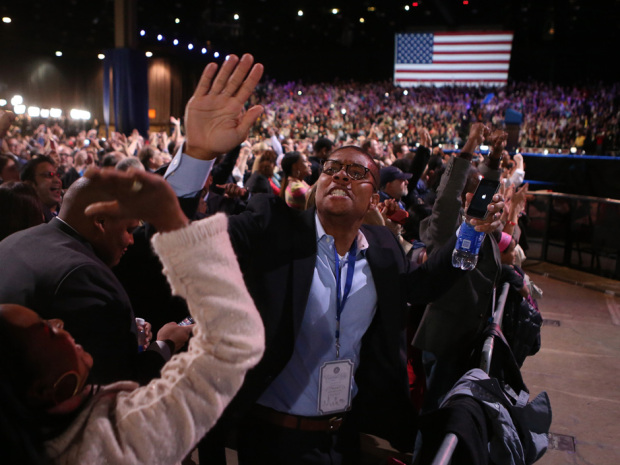
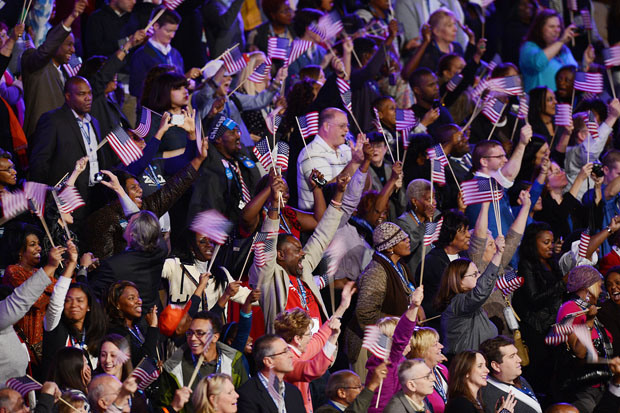
| Supporters of US President Barack Obama cheer results on election night November 6, 2012 in Chicago, Illinois. AFP PHOTO / Saul LOEBSAUL LOEB/AFP/Getty Images |
The long campaign’s cost soared into the billions, much of it spent on negative ads, some harshly so.
In the presidential race, an estimated one million commercials aired in nine battleground states where the rival camps agreed the election was most likely to be settled – Ohio, New Hampshire, Virginia, Florida, North Carolina, Wisconsin, Iowa, Colorado and Nevada.
In a months-long general election ad war that cost nearly $1 billion, Romney and Republican groups spent more than $550 million and Obama and his allies $381 million, according to organizations that track advertising.
In Virginia, the polls had been closed for several minutes when Obama’s campaign texted a call for volunteers “to make sure everyone who’s still in line gets to vote.”
In Florida, there were long lines at the hour set for polls to close. Under state law, everyone waiting was entitled to cast a ballot.
According to the exit poll, 53 percent of voters said Obama is more in touch with people like them, compared to 43 percent for Romney.
About 60% said taxes should be increased, taking sides on an issue that divided the president and Romney. Obama wants to let taxes rise on upper incomes, while Romney does not.
Other than the battlegrounds, big states were virtually ignored in the final months of the campaign. Romney wrote off New York, Illinois and California, while Obama made no attempt to carry Texas, much of the South or the Rocky Mountain region other than Colorado.
There were 33 Senate seats on the ballot, 23 of them defended by Democrats and the rest by Republicans.
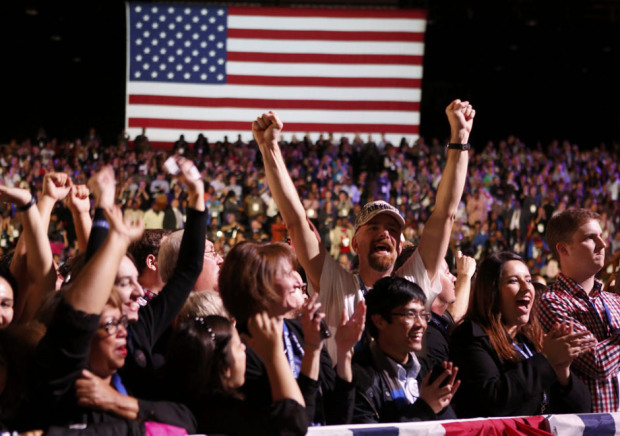
| REUTERS/Kevin Lamarque: Supporters of U.S. President Obama cheer during his election night rally in Chicago |
The GOP needed a gain of three for a majority if Romney won, and four if Obama was re-elected. Neither Majority Leader Harry Reid of Nevada nor GOP leader Mitch McConnell of Kentucky was on the ballot, but each had high stakes in the outcome.
All 435 House seats were on the ballot, including five where one lawmaker ran against another as a result of once-a-decade redistricting to take population shifts into account. Democrats needed to pick up 25 seats to gain the majority they lost two years ago.
Depending on the outcome of a few races, it was possible that white men would wind up in a minority in the Democratic caucus for the first time.
Speaker John A. Boehner, R-Ohio, raised millions to finance get-out-the-vote operations in states without a robust presidential campaign, New York, Illinois and California among them. His goal was to minimize any losses, or possibly even gain ground, no matter Romney’s fate. House Democratic leader Rep. Nancy Pelosi of California campaigned aggressively, as well, and faced an uncertain political future if her party failed to win control.
In gubernatorial races, Republicans picked up North Carolina, where Pat McCrory won easily. The incumbent, Democratic Gov. Bev Purdue, did not seek re-election.
In a campaign that traversed contested Republican primaries last winter and spring, a pair of political conventions this summer and three presidential debates, Obama, Romney, Biden and Ryan spoke at hundreds of rallies, were serenaded by Bruce Springstein and Meat Loaf and washed down hamburgers, pizza, barbecue and burrito bowls.
Obama was elected the first black president in 2008, and four years later, Romney became the first Mormon to appear on a general election ballot. Yet one man’s race and the other’s religion were never major factors in this year’s campaign for the White House, a race dominated from the outset by the economy.
Over and over, Obama said that during his term the nation has begun to recover from the worst recession since the Great Depression. While he conceded progress has been slow, he accused Romney of offering recycled Republican policies that have helped the wealthy and harmed the middle class in the past and would do so again.
Romney countered that a second Obama term could mean a repeat recession in a country where economic growth has been weak and unemployment is worse now than when the president was inaugurated. A wealthy former businessman, he claimed the knowledge and the skills to put in place policies that would make the economy healthy again.
In a race where the two men disagreed often, one of the principal fault lines was over taxes. Obama campaigned for the renewal of income tax cuts set to expire on Dec. 31 at all income levels except above $200,000 for individuals and $250,000 for couples.
Romney said no one’s taxes should go up in uncertain economic times. In addition, he proposed a 20 percent cut across the board in income tax rates but said he would end or curtail a variety of tax breaks to make sure federal deficits didn’t rise.
The differences over taxes, the economy, Medicare, abortion and more were expressed in intensely negative advertising.
Obama launched first, shortly after Romney dispatched his Republican foes in his quest for the party nomination.
One memorable commercial showed Romney singing an off-key rendition of “America The Beautiful.” Pictures and signs scrolled by saying that his companies had shipped jobs to Mexico and China, that Massachusetts state jobs had gone to India while he was governor and that he has personal investments in Switzerland, Bermuda and the Cayman Islands.
Romney spent less on advertising than Obama. A collection of outside groups made up the difference, some of them operating under rules that allowed donors to remain anonymous. Most of the ads were of the attack variety. But the Republican National Committee relied on one that had a far softer touch, and seemed aimed at voters who had been drawn to the excitement caused by Obama’s first campaign. It referred to a growing national debt and unemployment, then said, “He tried. You tried. It’s OK to make a change.”
More than 30 million voters cast early ballots in nearly three dozen states, a reflection of the growing appeal of getting a jump on the traditional Election Day. NP
Tuesday, October 30, 2012
Bali Teen Caught Having Sex With Chicken, Cow
| Illustration |
The boy, who has been identified by the initials KS, was discovered committing the act in a vacant lot of the Graha Indah housing complex in the district of Karangasem on Monday afternoon. He was soon handed over to police, who released him after some brief questioning.
“He committed no crime; he only committed an ethics violation. We have decided to let the local residents handle the problem,” Karangasem Police chief Comr. Putu Wijaya Arsa said on Tuesday.
“We suspect that the perpetrator has a mental problem,” he added.
Quoting KS, Wijaya said the boy had throttled the hen before having a sexual intercourse with it. KS claimed he did the deed after receiving an order from a spirit.
Supposedly, the spirit made him see the chicken as a beautiful girl.
“He said a spirit would keep disturbing him if he didn’t immediately do as it commanded,” Wijaya said.
Last month, KS was discovered having sex with a cow at the same housing complex.
“I witnessed him having intercourse with my cattle,” Wayan Sekar, the cow owner, said.
KS’s mother said her son was mentally troubled.
“I brought him to a psychic, who told me to watch over him every day.”
She added that her family was planning to organize a “pemelukatan” ceremony to rid KS of the evil spirit so he wouldn’t engage in similar acts in the future.
Ni Nyoman Suparni, an officer with the Bali office of the Child and Women’s Protection Group (KPPA), said the boy would be brought to Denpasar to consult with a psychiatrist.
KS is reportedly an elementary school graduate who now works construction.
Tuesday, October 23, 2012
Aceh Shuts Down Buddhist Temples and Churches
![]() |
| illustration picture |
Theophilus Bela, chairman of Jakarta Christian Communication Forum, said that the churches’ priests were forced to sign a statement to close their churches. Officials from the province that applies Shariah law supposedly made the demands in a meeting that was attended by several Islamic organizations, including the Islamic Defenders Front (FPI).
“It’s a blatant act of intolerance,” Theophilus said.
The churches include the Indonesian Bethel Church (GBI), the Pantekosta Church and the Indonesia Christian Church.
Nico Tarigan, a priest and head of GBI church, acknowledged that the permit needed for the church to remain open had not been issued from the mayor’s office, even though the paperwork for the permit had been submitted a long time ago.
“We admit we have not had the permit,” he said by telephone. “But they can’t just close down our church. We have 80 members that don’t know where to pray.”
Illiza Sa’aduddin Djamal, Banda Aceh deputy mayor, said that the nine churches and six temples have violated the city’s regulation, and should be closed down.
“The congregation members can join churches that have secured permits,” he said. “As a province that applies Islamist law, Aceh has a special law on this issue.”
He also called on Aceh’s Christians to respect the law.
However, Nico said that other churches were not necessarily open to members from other congregations.
“We hope there is a better solution from the Aceh government,” Nico said. “We have no motive to compete with other religions or ruin Islamic teaching. We have been here for eight years. They can ask local officials if we have done damage to Islamic teaching.”
“The FPI will continue to monitor these illegal churches and temples so that they don’t resume their activities,” said FPI chairman Yusuf Al-Qardhawy. JG
Friday, October 19, 2012
Lava Dome on Top of Mount Merapi Collapses
![]() |
| A lava dome of mount Merapi from Kaliadem, Agustus 23, 2010 (Reynold Sumayku/NGI) |
Tri Mujianto, from the Merapi mountain observatory in Jrakah, in the Selo subdistrict of Boyolali, said the lava dome had disappeared but he could not say precisely when.
"The dome is now no longer there but we were not able to monitor when it collapsed. Some [of the material] may have fallen inside [the crater] while some may have flowed into the channel of Apu River," he said.
They have not been able to determine the cause of the collapse, as there has been no rain in the crater area for days. They also haven't been able to estimate the volume of cold lava in the collapsed dome.
Tri said the alert status for Merapi remained at the normal level but warned that should rains fall over the crater, cold lava stream may flow down through natural river channels. A cold lava stream is congealed lava and other volcanic mud and debris flushed down the slopes of a volcano by heavy rains.
"Entering the rainy season, the frequency of cold lava stream is rising. We have checked the conditions at the craters several times and it appears to still be very much unstable. People on the slopes of Merapi, especially those living on the banks of rivers originating from the peak, should remain alert," he said.
Meanwhile, Subandriyo, the head of the Volcanology office in Yogyakarta, said that parts of the lava dome facing Boyolali district had collapsed, and ventured that it was due to its fragile condition.
"The collapse was not directly recorded because there were so many small deflagrations. On the scale, they did not even reach one kilometer down the slope," Subandriyo said.
He warned that rains with intensity of more than 20 millimeters and lasting more than two hours were enough to trigger flash floods of cold lava down the mountain's slope.
Guns n’ Roses Set To Make Jakarta Swoon, They Will Rock Out In Jakarta For The First Time
| Guns n’ Roses Jakarta concert: (Twitter.com/gunsnroses) |
Making only one stop in southeast Asia, GNR are set to invade the popular coastal town performing at the Lapangan D (D Field) Senayan, Jakarta on December 15, 2012.
This weekend, GNR will perform at Neil Young’s annual Bridge School Benefit concert, and then kick off their “Appetite For Democracy” residency at The Joint inside Hard Rock Hotel & Casino in Las Vegas, where the band will play 12 shows between October 31 and November 24.
“Appetite For Democracy” will span the band’s biggest hits from their debut album “Appetite For Destruction” (1987) through to “Chinese Democracy” (2008). Exact details about the show are being kept under wraps but fans can expect the raw and gritty heavy metal Guns N’ Roses is known for along with a few surprise elements.
| Lapangan D (D Field) Senayan |
The band made the surprise announcement through its Twitter account –
@gunsnroses – on Wednesday, prompting fans frenzy on social media
websites.
“Do you know where we’ll be on 12/15/12? We’ll be in Jakarta BABY!” the band said on its Twitter account on Wednesday.
They also posted a poster of the Jakarta concert, which will be held on Dec. 15 in the D field in Senayan, Central Jakarta.
Indika Production, the promoter, set pre-sale ticket prices ranging from Rp 660,000 (US$68.8) to Rp 2,200,000.
Founded in 1985 in the American city of Los Angeles, Guns n’ Roses initially comprised vocalist Axl Rose, guitarists Slash and Izzy Stradlin, bass player Duff McKagan and drummer Steve Adler.
In the upcoming Jakarta concert, Axl Rose, the only original band member remaining in the group, will be performing with guitarists DJ Ashba, Richard Fortus, Ron “Bumblefoot” Thal, bass player Tommy Stinson, keyboardists Dizzy Reed and Chris Pitman.
Rolling Stones Debut New Rockumentary In London
Band members Mick Jagger, Keith Richards, Ronnie Wood, Charlie Watts and former bassist Bill Wyman met dozens of fans outside the Odeon theatre in Leicester Square ahead of the screening.
Wyman said he hoped the film, named after the first line in smash hit "Jumpin' Jack Flash," highlighted the influence of guitarist Brian Jones, who died in 1969.
"I'm glad he's remembered, that's the most important thing," he said.
Looking back on the band's career, Jagger said: "It goes super fast so enjoy it while you can. It seems so that we did enjoy it while we could, it's pretty obvious."
The premiere caps a busy week for the iconic band, who confirmed on Monday they will play four gigs in Britain and the United States to mark their 50th anniversary.
Guitarist Wood revealed the band's live preparations were "up to and above par", joking that they "won't be able to stop" touring if the gigs were a success.
"I can't believe how well the band is sounding," he added.
The band play their hometown London at the 02 Arena on November 25 and 29, followed by two nights at the Newark Prudential Center in New Jersey, just outside New York, on December 13 and 15.
The live shows will be the first by Jagger, Richards, Watts and Wood for five years.
"You would think it would be boring doing the same thing over and over again but it's not," said Wood. "It's totally fresh and totally new every time we get together.
"There's a magic that comes when we get together. Individually we're kind of walking around the farm or, you know, unperturbed... but when we get together, the roof comes off."
He also hinted at a possible tour, saying: "Once this wheel is turning I don't think it will be able to stop."
The film, made by director Brett Morgen, will be shown in cinemas this month before being aired by the BBC2 later in the year. AFP
Thursday, October 18, 2012
WWII-era Spitfires to be excavated in Myanmar
![]() |
| About 20,000 Spitfires were built by Britain from 1938-1948 |
The iconic single-seat aircraft are believed to have been hidden -- unassembled in crates -- by the former colonial power to prevent them falling into Japanese hands almost seven decades ago.
"We expect to dig up about 60 fighters," said local businessman Htoo Htoo Zaw who is involved in the project which is expected to take about two years to complete.
Based on a survey of hundreds of witnesses, the team plans to dig in three locations in Yangon, northern Kachin state and central Mandalay.
If successfully excavated, some of the Spitfires are expected to be returned to Britain, which ruled Myanmar until independence in 1948 but was temporarily forced out of much of the country in 1942 by invading Japanese forces.
"We want to strengthen relations between Britain and our country and benefit millions of people in the world who want to see Spitfires," Htoo Htoo Zaw said.
The dig is the result of a more than decade-long search of former airforce bases in Myanmar by British farmer and aviation aficionado David Cundall using radar technology.
"I'm only a small farmer, I'm not a multi-millionaire and it has been a struggle. It took me more than 15 years but I finally found them," Cundall told British newspaper The Daily Telegraph earlier this year.
"Spitfires are beautiful aeroplanes and should not be rotting away in a foreign land. They saved our neck in the Battle of Britain and they should be preserved," he added.
"They were just buried there in transport crates," Cundall said. "They were waxed, wrapped in greased paper and their joints tarred. They will be in near perfect condition."
About 20,000 Spitfires were built by Britain from 1938-1948. The planes captured the public imagination during the Battle of Britain when the Royal Air Force prevented the German Luftwaffe from invading in 1940.
Today just a few dozen are still in flying condition.
An agreement on retrieving the historic planes was signed by a transport ministry senior official, David Cundall and Htoo Htoo Zaw in the capital Naypyidaw on Tuesday.
The British government welcomed the agreement, which follows the personal intervention of Prime Minister David Cameron, who discussed the Spitfires with President Thein Sein during his visit to Myanmar earlier this year.
The signing "marks an important step towards uncovering, restoring and displaying these fighter planes, and perhaps even seeing some of the aircraft gracing the skies of Britain in the future," an embassy spokesperson said.
Wednesday, October 17, 2012
Indonesia's Pancasila Classes to be Reintroduced in Bid to Quell School Violence
![]() |
| Pancasila state ideology classes will be one of six courses offered to elementary school students. (JG Photo/Ali Lufti) |
The decision was made by the Ministry of Education and Culture following a series of fatal brawls in high schools and university campuses, not to mention horizontal conflicts in various parts of the country.
Politicians and community leaders alike have expressed worry that an absence of Pancasila courses has also triggered a rise in ethnic and religious intolerance which could result in national disintegration if abandoned any further.
Pancasila, Indonesia’s state ideology, was ingrained into school curriculums a during former president Suharto’s three decades of dictatorial rule. Critics accused him of using the Pancasila Propagation Course, then known as P4, as a political indoctrination instrument to cement his power. As a result, his ouster in 1998 spelled an end to Pancasila’s inclusion in school curricula.
In July 2003, President Megawati Sukarnoputri signed Law No.20/2003 that resulted in Pancaila courses being scrapped from schools. Megawati’s father, former president Sukarno, was the one who introduced Pancasila as the nation’s guiding ideology on June 1, 1945, prior to independence.
Historian Asvi Warman Adam placed blame on the former government for Pancasila’s absence in schools. He has urged then-education minister Bambang Sudiby to apologize to the public for having made “such a frivolous blunder.”
Retno Listyarti, secretary general of the Federation of Indonesian Teachers Associations (FSGI), said that it is not enough just to reinstate Pancasila in schools — the government must instill the right culture based on the values of the state ideology, especial religious tolerance toward minority groups, because Indonesia is a pluralist society.
She said that discriminative treatment toward students from minority groups was flourishing in public schools. “Civic education must lead to greater tolerance toward our pluralistic reality. The Indonesian state is not based on religious ideologies but on Pancasila,” she explained.
“For example, there are schools that oblige all students to read the Koran or [force] female students to wear Muslim dresses every Friday,” Retno told the daily Suara Pembaruan on Monday.
The Deputy Minister of Education, Muslia Kasin, had said that the government planned to change the name of PPKn civic education course to Pancasila Education.
PPKn as a subject matter was introduced during the 2004 academic year, but the terminology of Pancasila was omitted.
Meanwhile, rector of state-owned Yogyakarta University, Rochmat Wahab, said what is important is not verbalistic changes but the true implementation of the state ideology within society. The government must make sure that Pancasila courses will not only serve the interests of those in power, the academic said.
On Tuesday, Vice President Boediono threw his weight behind the move to reinstate Pancasila in schools, stating that Indonesian students were in dire need of soft skills, including character building based on the values of the state ideology.
“There aren’t soft skill lessons in our schools, and I have the impression that we have not given sufficient attention to promoting [these] skills in the younger generation,” Boediono said.
Such abilities are needed to groom Indonesia’s future leaders in all fields, the vice president explained. “This will determine the pace of our civilization.”
Boediono noted that an absence of the serious development of character in schools in is to blame for frequent student brawls, violent acts, corruption, markup and bribery. “And we wonder why have all these things happened?”
Education must provide an answer to such social maladies, Boediono noted. “My appeal is that all schools at all levels must teach soft skills as [well] as hard skills.”
But religious educators Maman Imanulhaq and Benny Susetyo warned that Pancasila education is not just for students, but for the political elite, as well.
They argued that the government does not take proper action when citizens suffer from discriminatory treatment and religious intolerance.
Maman, an educator at Al Mizani Islamic boarding school in Majalengka, West Java, said that such government inaction is proof that the political elite have failed to implement Pancasila in the real world.
Benny, the executive secretary of inter-religious relations at the Indonesian Catholic Bishops Conference, said that political elites have even “parked Pancasila” and replaced it with pragmatism and trans-nationalism. “Corruption is on the rise, as is oppression, greed and violent behavior that endangers tolerance,” Benny warned.
Nahdlatul Ulama’s Ansor Youth organization’s chairman Nusron Wahid expounded the statement by saying that a number of groups are “forcing their own interpretations of religious teachings from narrow-minded perspectives.”
Earlier reports said the education ministry was planning to remove science and English studies from elementary schools, because the ministry believes that young students shouldn’t be studying too much.
Deputy Education Minister Musliar Kasim said that his ministry is drafting a new curriculum that contains only six subjects: religion, nationalism, Indonesian language, math, art and sport.
Besides scrapping science and social studies from the curriculum, as announced on Sept. 27, the government also intends to eliminate English language lessons.
Science and social studies will be integrated into Indonesian language classes. “So, when learning the Indonesian language, students could study about thunder or rain while learning to read,” the deputy minister said.
However, many education experts have said that the policy would hurt Indonesia.
In other countries, science is taught in elementary school in order to cultivate a critical and scientific culture early.
Educational observer Darmaningtyas said it was wrong to abolish or postpone sciences at elementary school.
“I agree with reinstatement of Pancasila. ... However, it should not be done at the expense of science and English. How can we compete at the international level if we don’t master English and science?” Darmaningtyas said. JG
Subscribe to:
Posts (Atom)

Barack Obama